241 posters, 10 topics, 7 sessions, 899 authors, 296 institutions
ePostersLive by SciGen Technologies S.A. All rights reserved.
The AAPS 103rd Annual Meeting 2025
May 24-27, 2025 | Austin, Texas

D76
Sociodemographic Drivers Of Reconstructive Care Following Mohs Micrographic Surgery
Poster Presenter
Authors
Goutam Gadiraju, Renee Gao, Andrew Malek, Yibin Zhang, Yizhuo Shen, Alan Yang, Justin Broyles
Affiliations
University of Pennsylvania, Harvard Medical School, Yale School of Medicine, University of Massachusetts, Chan Medical School, Louisiana State University Health Sciences Center, School of Medicine, Division of Plastic and Reconstructive Surgery, Department of Surgery, Brigham and Women’s Hospital
Part of Topic
Education/Practice Management/Other
Background:
Mohs Micrographic Surgery (MMS) is used widely in treating skin cancers in sensitive areas. Reconstruction is typically performed by MMS or plastic and reconstructive surgeons (PRS). MMS have performed a growing share in recent years1, but little is known regarding factors that drivePRS referrals across the following characteristics: Sociodemographic, Oncologic and Procedural Data, Financials and Reimbursement Data.
Objectives:
• Identify factors that drive PRS referrals after MMS.
• Analyze reimbursements to assess economic influences and impacts of insurance status on referral patterns.
Methods:
• The Massachusetts All-Payer Claims Database (APCD) was queried for claims data for patients who underwent MMS for head and neck cancer between 2016-2020.
• We included patients who were treated for a single episode of MMS during the study period.
• Primary Outcome: PRS Referral after MMS.
Results:
• 70,308 total patients were included.
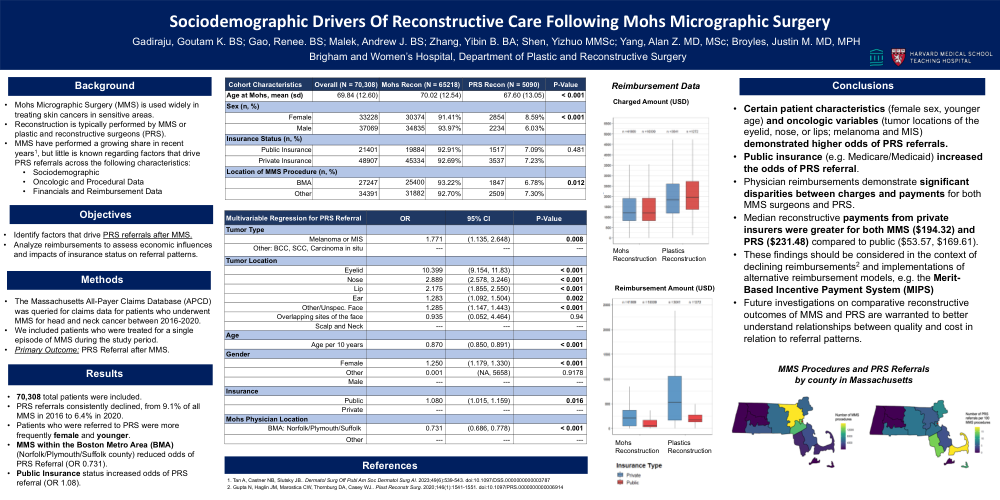
• PRS referrals consistently declined, from 9.1% of all MMS in 2016 to 6.4% in 2020.
• Patients who were referred to PRS were more frequently female and younger.
• MMS within the Boston Metro Area (BMA) (Norfolk/Plymouth/Suffolk county) reduced odds of PRS Referral (OR 0.731).
• Public Insurance status increased odds of PRS referral (OR 1.08).
Conclusions:
• Certain patient characteristics (female sex, younger age) and oncologic variables (tumor locations of the eyelid, nose, or lips; melanoma and MIS) demonstrated higher odds of PRS referrals.
• Public insurance (e.g. Medicare/Medicaid) increased the odds of PRS referral.
• Physician reimbursements demonstrate significant disparities between charges and payments for both MMS surgeons and PRS.
• Median reconstructive payments from private insurers were greater for both MMS ($194.32) and PRS ($231.48) compared to public ($53.57, $169.61).
• These findings should be considered in the context of declining reimbursements2 and implementations of alternative reimbursement models, e.g. the Merit-Based Incentive Payment System (MIPS)
• Future investigations on comparative reconstructive outcomes of MMS and PRS are warranted to better understand relationships between quality and cost in relation to referral patterns.