241 posters, 10 topics, 7 sessions, 899 authors, 296 institutions
ePostersLive by SciGen Technologies S.A. All rights reserved.
The AAPS 103rd Annual Meeting 2025
May 24-27, 2025 | Austin, Texas

D74
No Compromise In Care: Plastic Surgery Resident Involvement On DIEP Flap Outcomes In A High-Volume Microsurgical Breast Practice
Part of Topic
Education/Practice Management/Other
No Compromise In Care: Plastic Surgery Resident Involvement On DIEP Flap Outcomes In A High-Volume Microsurgical Breast Practice
Eric Zeng, BS1; Samuel Kogan, MD, PhD2; Joyce Cui, BA1; Mary Duet, MD2; Marion Tapp, MD2; J. Michael Robinson, MD3; Christopher Runyan, MD, PhD2
INTRODUCTION
Resident involvement in complex microsurgical procedures is essential for advancing surgical training, yet it often raises concerns amongst patients and surgeons.
While general surgical outcomes have been studied, the impact of resident participation in microsurgery remains underexplored.
This study leverages a unique case control-like opportunity from a healthcare merger to evaluate plastic surgery resident involvement in a high-volume microsurgical breast practice.
METHODS
Retrospective review on 395 patients who underwent DIEP flap reconstruction from December 2021 to May 2024. Demographics, operative details, and postoperative outcomes were analyzed.
Patients were stratified into three cohorts: dual attendings without a resident (n = 174), with a plastic surgery resident (n = 147), or with a general surgery resident (n = 38).
Statistical analysis was performed in R Studio using T-tests and Mann-Whitney U tests for continuous variables, Fisher’s Exact tests for categorical variables, and Shapiro-Wilk tests for normality.
OBJECTIVE
To evaluate the impact of plastic surgery resident involvement on postoperative outcomes in DIEP flap breast reconstruction, addressing the gap in research on resident participation in complex microsurgery.
RESULTS
CONCLUSION
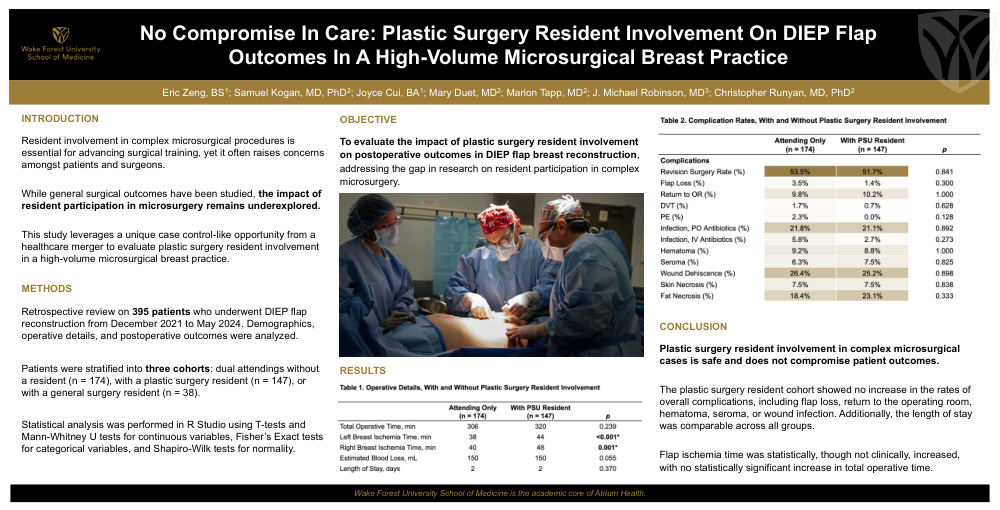
Plastic surgery resident involvement in complex microsurgical cases is safe and does not compromise patient outcomes.
The plastic surgery resident cohort showed no increase in the rates of overall complications, including flap loss, return to the operating room, hematoma, seroma, or wound infection. Additionally, the length of stay was comparable across all groups.
Flap ischemia time was statistically, though not clinically, increased, with no statistically significant increase in total operative time.