203 posters, 14 topics, 5 sessions, 817 authors, 256 institutions
ePostersLive by SciGen Technologies S.A. All rights reserved.
The AAPS 102nd Annual Meeting
May 18-21, 2024 | The Westin Copley Place, Boston, MA

D40
Existing Psychiatric Diagnoses Interact With Outcomes After Autologous And Implant-based Breast Reconstruction: A Propensity Score Matched Analysis
Poster Presenter
Part of Topic
Breast Reconstruction
Introduction
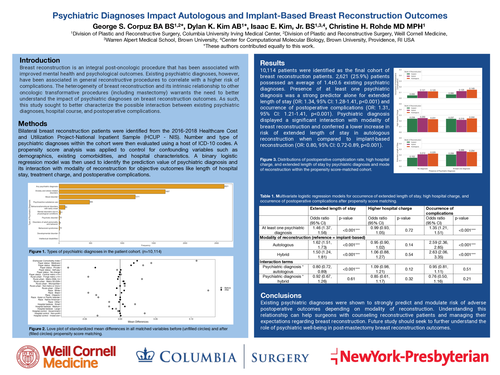
Breast reconstruction is an integral post-oncologic procedure that has been associated with improved mental health and psychological outcomes. Existing psychiatric diagnoses, however, have been associated in general reconstructive procedures to correlate with a higher risk of complications. The heterogeneity of breast reconstruction and its intrinsic relationship to other oncologic transformative procedures (including mastectomy) warrants the need to better understand the impact of psychiatric diagnoses on breast reconstruction outcomes. As such, this study sought to better characterize the possible interaction between existing psychiatric diagnoses, hospital course, and postoperative complications.
Methods
Bilateral breast reconstruction patients were identified from the 2016-2018 Healthcare Cost and Utilization Project-National Inpatient Sample (HCUP - NIS). Number and type of psychiatric diagnoses within the cohort were then evaluated using a host of ICD-10 codes. A propensity score analysis was applied to control for confounding variables such as demographics, existing comorbidities, and hospital characteristics. A binary logistic regression model was then used to identify the prediction value of psychiatric diagnosis and its interaction with modality of reconstruction for objective outcomes like length of hospital stay, treatment charge, and postoperative complications.
Results
10,114 patients were identified as the final cohort of breast reconstruction patients. 2,621 (25.9%) patients possessed an average of 1.4±0.6 existing psychiatric diagnoses. Presence of at least one psychiatric diagnosis was a strong predictor alone for extended length of stay (OR: 1.34, 95% CI: 1.28-1.41, p<0.001) and occurrence of postoperative complications (OR: 1.31, 95% CI: 1.21-1.41, p<0.001). Psychiatric diagnosis displayed a significant interaction with modality of breast reconstruction and conferred a lower increase in risk of extended length of stay in autologous reconstruction when compared to implant-based reconstruction (OR: 0.80, 95% CI: 0.72-0.89, p<0.001).
Conclusions
Existing psychiatric diagnoses were shown to strongly predict and modulate risk of adverse postoperative outcomes depending on modality of reconstruction. Understanding this relationship can help surgeons with counseling reconstructive patients and managing their expectations regarding breast reconstruction. Future study should seek to further understand the role of psychiatric well-being in post-mastectomy breast reconstruction outcomes.