Loading...

203 posters, 14 topics, 5 sessions, 817 authors, 256 institutions

ePostersLive by SciGen Technologies S.A. All rights reserved.

The AAPS 102nd Annual Meeting

May 18-21, 2024 | The Westin Copley Place, Boston, MA

The AAPS 102nd Annual Meeting banner

D121

Impact Of Covid-19 On Thrombotic Complications In Microsurgery
Part of Topic

Breast Reconstruction

Impact of Covid-19 on Thrombotic Complications in Microsurgery

Daniel P. Zaki, MD MS | Department of Plastic & Reconstructive Surgery, Wake Forest University School of Medicine
with Marion Tapp, MD; Mary Duet, BS; Spencer Giglio, BS; Ramon Llull, MD, PhD; Bennett Calder, MD; J. Michael Robinson, MD

Background:

•Autologous reconstruction with the deep inferior epigastric perforator (DIEP) flap is the gold standard for breast reconstruction in patients with radiation. 
•Microsurgery, utilized for vessel anastomosis in the DIEP flap procedure is highly effective:
•Associated with up to 97% success rate. However, in patients in hypercoagulable states success drops to 85%.
•Possible causes of free flap failure include vascular occlusion, prolonged ischemia time, and pedicle revision.
•Not included in the commonly used risk assessment scores is COVID-19 infection or vaccination. 
•Research suggests Increased risk of vasculitis, microvascular thrombi, and thromboembolic events in patients with complications of SARS-CoV-2.
•Research is mixed regarding the effects of COVID-19 vaccinations on hyper-thrombotic events and complications of microvascular surgery.


Methods:

•IRB review was conducted of women undergoing autologous breast reconstruction between January 2019 and March 2022. 
•Patient history and postoperative complications were  collected.
•Patients were divided into 3 cohorts based on date of surgery and history of infection or vaccine.
 
Results:
 

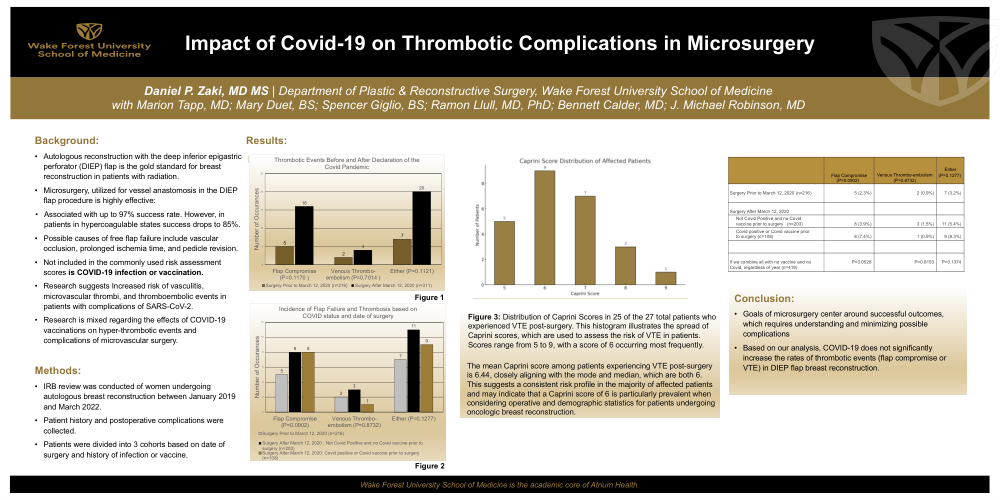
Figure 3: Distribution of Caprini Scores in 25 of the 27 total patients who experienced VTE post-surgery. This histogram illustrates the spread of Caprini scores, which are used to assess the risk of VTE in patients. Scores range from 5 to 9, with a score of 6 occurring most frequently.


The mean Caprini score among patients experiencing VTE post-surgery is 6.44, closely aligning with the mode and median, which are both 6. This suggests a consistent risk profile in the majority ofaffected patients and may indicate that a Caprini score of 6 is particularly prevalent when considering operative and demographic statistics for patients undergoing oncologic breast reconstruction. 


Conclusion:

•Goals of microsurgery center around successful outcomes, which requires understanding and minimizing possible complications
•Based on our analysis, COVID-19 does not significantly increase the rates of thrombotic events (flap compromise or VTE) in DIEP flap breast reconstruction. 
The AAPS 102nd Annual Meeting » banner
Copyright © 2015-2026, ePostersLive® SciGen is a registered trademark of SciGen Technologies S.A. Patent pending.

This website and third-party tools we use rely on cookies for the best user experience. By selecting "I agree", you agree to cookie usage as described in our Privacy Policy.