203 posters, 14 topics, 5 sessions, 817 authors, 256 institutions
ePostersLive by SciGen Technologies S.A. All rights reserved.
The AAPS 102nd Annual Meeting
May 18-21, 2024 | The Westin Copley Place, Boston, MA

D35
No Drains, No Problem: A Propensity Score Matched Outcomes Analysis Of Dual-port Vs Single-port Tissue Expanders
Part of Topic
Breast Reconstruction
No Drains, No Problem: A Propensity Score Matched Outcomes Analysis of Dual-port vs. Single-port Tissue Expanders
Introduction
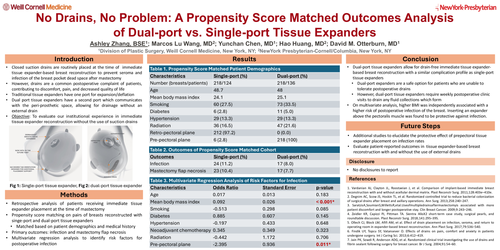
•Closed suction drains are routinely placed at the time of immediate tissue expander-based breast reconstruction to prevent seroma and infection of the breast pocket dead space after mastectomy
•However, drains are a common postoperative complaint of patients, contributing to discomfort, pain, and decreased quality of life
•Traditional tissue expanders have one port for expansion/deflation
•Dual port tissue expanders have a second port which communicates with the peri-prosthetic space, allowing for drainage without an external drain
•Objective: To evaluate our institutional experience in immediate tissue expander reconstruction without the use of suction drains
Methods
•Retrospective analysis of patients receiving immediate tissue expander placement at the time of mastectomy
•Propensity score matching on pairs of breasts reconstructed with singe-port and dual-port tissue expanders
•Matched based on patient demographics and medical history
•Primary outcomes: infection and mastectomy flap necrosis
•Multivariate regression analysis to identify risk factors for postoperative infection
Conclusion
•Dual-port tissue expanders allow for drain-free immediate tissue expander-based breast reconstruction with a similar complication profile as single-port tissue expanders
•Dual-port expanders are a safe option for patients who are unable to tolerate postoperative drains
•However, dual-port tissue expanders require weekly postoperative clinic visits to drain any fluid collections which form
•On multivariate analysis, higher BMI was independently associated with a higher risk of postoperative infection of the breast. Inserting an expander above the pectoralis muscle was found to be protective against infection.
Future Steps
•Additional studies to elucidate the protective effect of prepectoral tissue expander placement on infection rates
•Evaluate patient-reported outcomes in tissue expander-based breast reconstruction with and without the use of external drains