203 posters, 14 topics, 5 sessions, 817 authors, 256 institutions
ePostersLive by SciGen Technologies S.A. All rights reserved.
The AAPS 102nd Annual Meeting
May 18-21, 2024 | The Westin Copley Place, Boston, MA

D32
Identifying Traits In The Breast Implant Microbiome That Leads To Capsular Contracture After Breast Augmentation: A Case-control Study Of 141 Implants Using Next Generation Sequencing
Poster Presenter
Authors
Tim K Weltz, Shuang Peng, Andreas Larsen, Erik E F Bak, Sif Mathisen, Mathilde N Hemmingsen, Louise V Mielke, Jesper Trillingsgaard, Jens J Elberg, Lisbet R Hölmich, Peter Vester-Glowinski, Blaine Fritz, Thomas Bjarnsholt, Urvish Trivedi, Xuanji Li, Søren J Sørensen, Mikkel Herly
Affiliations
Copenhagen University Hospital, Rigshospitalet, Department of Plastic Surgery and Burns Treatment, Copenhagen University Hospital, Rigshospitalet, Section of Microbiology, Department of Biology, University of Copenhagen, Aleris-Hamlet, Copenhagen, AK Nygart, Copenhagen, Amalieklinikken, Copenhagen, Department of Plastic and Reconstructive Surgery, Copenhagen University Hospital, Herlev and Gentofte, Department of Immunology and Microbiology, University of Copenhagen
Part of Topic
Basic Science Research
BACKGROUND
Subclinical infection of breast implants has
been suggested to trigger capsular
contracture.
PATIENTS
We included 141 implants from 72 healthy
women undergoing implant exchange with
and without capsular contracture. They were
matched for time of implantation, implant
brand and surface texture.
Thirty-eight patients acted as their own
control contributing with one breast with
capsular contracture (Baker III/IV) and a
healthy contralateral breast (Baker I).
Sixteen patients were Baker I bilaterally, 15
patients were Baker III/IV bilaterally and
three patients contributed with one breast
with Baker III/IV.
METHODS
The entire implant was sonicated for
isolation of bacteria before extraction of
bacterial DNA and analyzed with amplicon
sequencing of the hypervariable V3-V4
region of the bacterial 16S rRNA gene on the
Illumina MiSeq Platform.
RESULTS
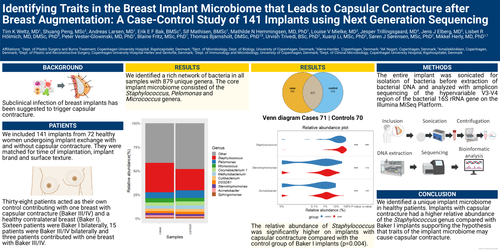
We identified a rich network of bacteria in all
samples with 879 unique genera. The core
implant microbiome consisted of the
Staphylococcus, Pelomonas and
Micrococcus genera.
The relative abundance of Staphylococcus
was significantly higher on implants with
capsular contracture compared with the
control group of Baker I implants (p=0.004).
CONCLUSION
We identified a unique implant microbiome
in healthy patients. Implants with capsular
contracture had a higher relative abundance
of the Staphylococcus genus compared with
Baker I implants supporting the hypothesis
that traits of the implant microbiome may
cause capsular contracture.