203 posters, 14 topics, 5 sessions, 817 authors, 256 institutions
ePostersLive by SciGen Technologies S.A. All rights reserved.
The AAPS 102nd Annual Meeting
May 18-21, 2024 | The Westin Copley Place, Boston, MA

D115
A Role For Tannic Acid In Restoring Elastogenesis Impaired By Common Aesthetic Agents
Poster Presenter
Authors
Affiliations
Part of Topic
Basic Science Research
A Role For Tannic Acid In Restoring Elastogenesis
Impaired By Common Aesthetic Agents
Shawn J. Loder, MD1, J. P. Rubin, MD1, Thomas Mitts, MD2, Aleksander Hinek, PHD2
1University of Pittsburgh, Pittsburgh, PA, USA, 2Elastogenesis, LLC, Visalia, CA, USA
Background
Aesthetic management of aging skin relies on precise
extracellular matrix (ECM) homeostasis to maximize
youthful resilience, fullness, and elasticity while
mitigating risk of dermal fibroses.
• Elastogenesis is critical to this.
• Currently, several ‘natural agents’ - growth factors,
vitamins C and D3, hyaluronic acid (HA), and ferulic
acid (FA) - are marketed to augment aesthetic
outcomes in plastic surgery
• These agents carry pleiotropic effects on ECM
homeostasis and with some hindering elastic fiber
formation while promoting fibrosis.
• Our team has demonstrated the benefit of tannic acids
(TAs) to protect new elastic fibers from degradation.
Aims
Here we sought to assay these agents with or without
TAs to evaluate for ECM modifications.
Methods
In vitro evaluation of:
• a) dermal fibroblast culture from skin biopsy, female
(n=3)
• Parallel culture was maintained in the presence or
absence of tannic acid (TA) at 2.0 and 20.0 uM (Fig A)
• Samples treated with Vitamin D3, Hyaluronic Acid (HA)
(0.1%), and Ferulic Acid (FA) (20 uM), or CUSO4 (2 uM).
• Stimulation assay with IGF-1 and TGFbeta-1
• Immunofluorescence for Collagen 1 and/or Elastin.
Assessed by Morphometry per High-Power Field, Real-
Time PCR, and Insoluble Elastin Production.
Data
Results
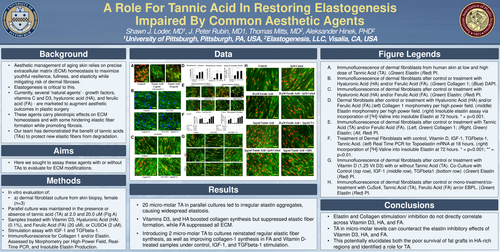
20 micro-molar TA in parallel cultures led to irregular elastin aggregates,
causing widespread elastosis.
• Vitamins D3, and HA boosted collagen synthesis but suppressed elastic fiber
formation, while FA suppressed all ECM.
• Introducing 2 micro-molar TA to cultures reinstated regular elastic fiber
synthesis, as well as improving collagen-1 synthesis in FA and Vitamin D-
treated samples under control, IGF-1, and TGFbeta-1 stimulation.
Figure Legends
A. Immunofluorescence of dermal fibroblasts from human skin at low and high
dose of Tannic Acid (TA). (Green) Elastin (Red) PI.
B. Immunofluorescence of dermal fibroblasts after control or treatment with
Hyaluronic Acid (HA) and/or Ferulic Acid (FA). (Green) Collagen 1; (Blue) DAPI.
C. Immunofluorescence of dermal fibroblasts after control or treatment with
Hyaluronic Acid (HA) and/or Ferulic Acid (FA). (Green) Elastin; (Red) PI.
D. Dermal fibroblasts after control or treatment with Hyaluronic Acid (HA) and/or
Ferulic Acid (FA).(left) Collagen 1 morphometry per high power field. (middle)
Elastin morphometry per high power field. (right) Insoluble elastin assay via
incorporation of [3H]-Valine into insoluble Elastin at 72 hours. * = p<0.001
E. Immunofluorescence of dermal fibroblasts after control or treatment with Tannic
Acid (TA) and/or Ferulic Acid (FA). (Left, Green) Collagen 1; (Right, Green)
Elastin; (All, Red) PI.
F. Treatment of Dermal Fibroblasts with control, Vitamin D, IGF-1, TGFbeta-1,
Tannic Acid. (left) Real Time PCR for Topoelastin mRNA at 18 hours. (right)
Incorporation of [3H]-Valine into insoluble Elastin at 72 hours. * = p<0.001; ** =
p<0.01
G. Immunofluorescence of dermal fibroblasts after control or treatment with
Vitamin D (1,25 Vit D3) with or without Tannic Acid (TA). Co-Culture with
Control (top row), IGF-1 (middle row), TGFbeta1 (bottom row). (Green) Elastin
(Red) PI.
H. Immunofluorescence of dermal fibroblasts after control or mono-treatment/co-
treatment with CuSo4, Tannic Acid (TA), Ferulic Acid (FA) an/or EBPL. (Green)
Elastin (Red) PI.
Conclusions
Elastin and Collagen stimulation/ inhibition do not directly correlate
across Vitamin D3, HA, and FA.
• TA in micro-molar levels can counteract the elastin inhibitory effects of
Vitamin D3, HA, and FA.
• This potentially elucidates both the poor survival of fat grafts in HA-rich
regions and identified a role for TA.