203 posters, 14 topics, 5 sessions, 817 authors, 256 institutions
ePostersLive by SciGen Technologies S.A. All rights reserved.
The AAPS 102nd Annual Meeting
May 18-21, 2024 | The Westin Copley Place, Boston, MA

D28
Are Drains Protective In Greater Resection Weights? A Retrospective Cohort Study Of 1,098 Reduction Mammoplasties Using The Superomedial Pedicle Wise-pattern Technique
Poster Presenter
Authors
Christian Lava, Samuel Huffman, Karen Li, Isabel Snee, Alice Bell, Jenna Bekeny, Rajiv Parikh, Samer Jabbour, Laura Tom, Stephen Baker, Kenneth Fan
Affiliations
Georgetown University School of Medicine, Department of Plastic and Reconstructive Surgery, MedStar Georgetown University Hospital, Department of Plastic and Reconstructive Surgery, MedStar Washington Hospital Center, Department of Plastic and Reconstructive Surgery, MedStar Good Samaritan Hospital
Part of Topic
Breast Reconstruction
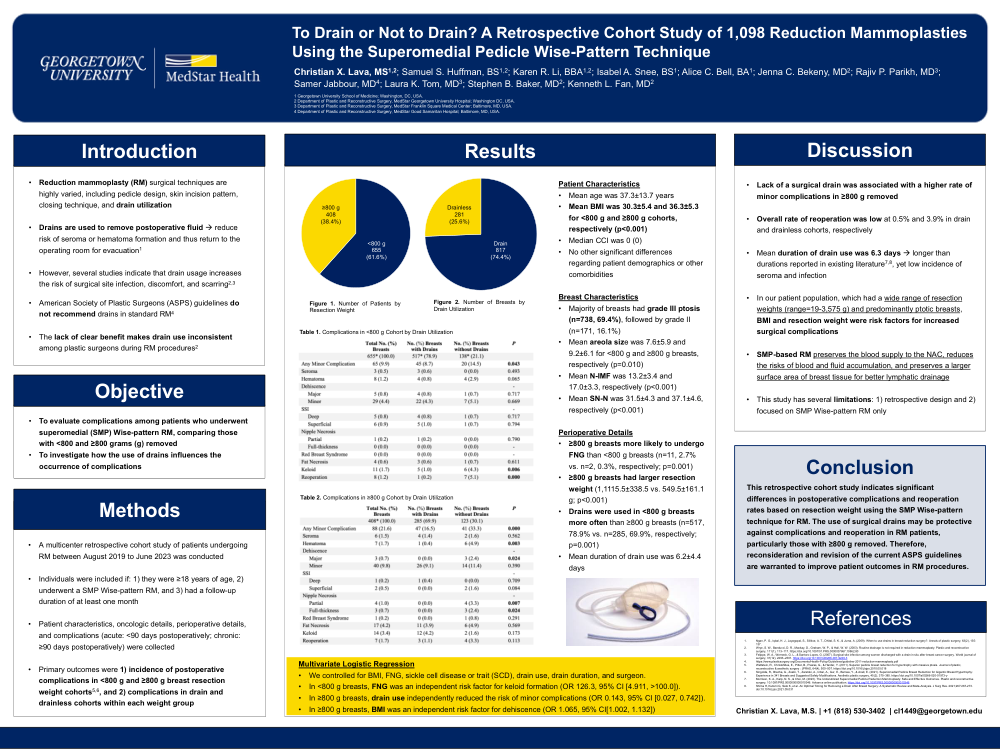
To Drain or Not to Drain? A Retrospective Cohort Study of 1,098 Reduction Mammoplasties Using the Superomedial Pedicle Wise-Pattern Technique
Background: Drains are frequently used in reduction mammoplasties (RM) to minimize the chance of seroma or hematoma formation, but risk drain site infection, discomfort, and scarring. The use of drains for RM is inconsistent among plastic surgeons. We aim to evaluate complications among patients who underwent superomedial pedicle (SMP) Wise-pattern RM, comparing those with <800 and ≥800 g removed, and investigate the impact of drain use on the occurrence of complications.
Methods: A multicenter retrospective review of all patients undergoing RM procedures from August 2019 to June 2023 was conducted. Demographic data, comorbidities, operative details, and postoperative complications were collected. Postoperative complications were categorized into minor and major (i.e., reoperation).
Results: 563 patients (1,098 breasts) underwent SMP Wise-pattern RM. Of the 541 (96.1%) patients with resection weights available, 335 (61.9%) had <800 g removed and 206 (38.1%) had ≥800 g removed. 414 patients (73.5%) had drains placed (817 breasts, 74.4%) while 150 patients (26.6%) did not (281 breasts, 25.6%). Mean age was 37.3±14.2 and 37.4±12.9 years for <800 g and ≥800 g cohorts, respectively (p=0.720). Mean BMI was 30.3±5.4 and 36.3±5.3 kg/m2 for <800 g and ≥800 g cohorts, respectively (p<0.001). Mean duration of drain use were 6.5±4.4 and 5.8±4.1 days for <800 g and ≥800 g breasts, respectively (p=0.052). Amongst <800 g breasts, drainless had a significantly higher rate of minor complications (n=20, 14.5% vs. n=45, 8.7%; p=0.043) and reoperation (n=7, 5.1% vs. n=1, 0.2%; p<0.001). Amongst ≥800 g breasts, drainless had a significantly higher rate of major dehiscence (n=3, 2.4% vs. n=0, 0.0%; p=0.024), hematoma (n=6, 4.9%; p=0.003 vs. n=1, 0.4%; p=0.003), partial nipple necrosis (n=4, 3.3% vs. n=0, 0.0%; p=0.007), and full-thickness nipple necrosis (n=3, 2.4% vs. n=0, 0.0%; p=0.024). In the multivariate logistic regression model, for ≥800 g breasts, the odds of developing minor complications were lower in those with drains than in those without (OR 0.143, 95% CI [0.027, 0.742]).
Conclusion: In SMP-based RMs, the use of a surgical drain was associated with a lower rate of minor complications in ≥800 g removed. The use of drains is safe and protective against postoperative complications and reoperation, regardless of resection weight.