203 posters, 14 topics, 5 sessions, 817 authors, 256 institutions
ePostersLive by SciGen Technologies S.A. All rights reserved.
The AAPS 102nd Annual Meeting
May 18-21, 2024 | The Westin Copley Place, Boston, MA

D7
Dermabond For Reduction Mammoplasty Revisited: Its Effects On Postoperative Wound Healing
Part of Topic
Aesthetic Breast/Body Contouring
Dermabond for Reduction Mammoplasty Revisited: Effects on Postoperative Wound Healing
Introduction:
• Wound dressing following reduction mammoplasty can be conducted using surface 2-Octyl cyanoacrylate (Dermabond; Ethicon, Inc., Somerville, N.J)1,2,3
• The effect on long-term wound healing in these patients is inconclusive4
• We present an updated review of Dermabond's safety and efficacy in reduction mammoplasty patients
• All reductions done by the same senior surgeon
• March 2015–February 2023
• Uni- and bilateral reductions included
• Dermabond: Four vials (0.5mL/vial) Dermabond + sterile gauze dressing
• No Dermabond: Bacitracin + non-adherent gauze + sterile gauze dressing
• Student's t-test or Wilcoxon rank sum test for continuous variables and Fisher's exact test for categorical variables to evaluate differences in demographics and postoperative outcomes between groups
• Univariate and multivariate logistic regression with Firth's correction to accommodate low frequencies of complications used to calculate odds ratios (ORs), adjusted odds ratios (aORs), and 95% confidence intervals (CIs).
• Average age = 38 ± 15 years old
• Average pre-operative BMI = 30.9 ± 5.0
• All identified as female
• 16% had hypertension, 5.3% had diabetes,
2.4% were current smokers
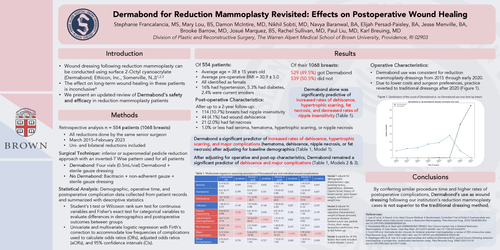
529 (49.5%) got Dermabond
539 (50.5%) did not
• Dermabond use was consistent for reduction mammoplasty dressings from 2015 through early 2020.
• 114 (10.7%) breasts had nipple insensitivity
• 44 (4.1%) had wound dehiscence
• 21 (2.0%) had fat necrosis
• 1.0% or less had seroma, hematoma, hypertrophic scarring, or nipple necrosis
Conclusions: By conferring similar procedure time and higher rates of postoperative complications, Dermabond’s use as wound dressing following our institution’s reduction mammoplasty cases is not superior to the traditional dressing method.