203 posters, 14 topics, 5 sessions, 817 authors, 256 institutions
ePostersLive by SciGen Technologies S.A. All rights reserved.
The AAPS 102nd Annual Meeting
May 18-21, 2024 | The Westin Copley Place, Boston, MA

D10
Balancing The Scales: Caution In Breast Reduction Recommendations For Obesity Class III Patients
Poster Presenter
Authors
Jane Ewing, Ellen Niu, Chris Amro, Zachary Gala, Mehdi Lemdani, Ashley Chang, Robyn Broach, Joseph Serletti, John Fischer
Affiliations
Part of Topic
Aesthetic Breast/Body Contouring
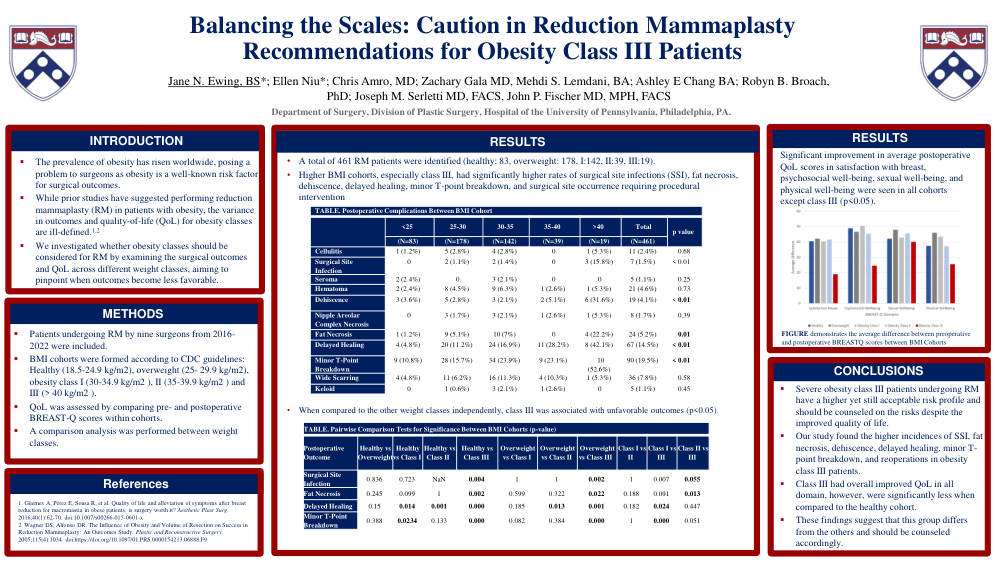
INTRODUCTION: The prevalence of obesity has risen worldwide, posing a problem to surgeons as obesity is a well-known risk factor for surgical outcomes. While prior studies have suggested performing reduction mammaplasty (RM) in patients with obesity, the variance in outcomes and quality-of-life (QoL) for obesity classes are ill-defined. We investigated whether obesity classes should be considered for RM by examining the surgical outcomes and QoL across different weight classes, aiming to pinpoint when outcomes become less favorable.
METHODS: Patients undergoing RM by nine surgeons from 2016-2022 were included. BMI cohorts were formed according to CDC guidelines: Healthy (18.5-24.9 kg/m2), overweight (25-29.9 kg/m2), obesity class I (30-34.9 kg/m2), II (35-39.9 kg/m2) and III (> 40 kg/m2). QoL was assessed by comparing pre- and postoperative BREAST-Q scores within cohorts. A comparison analysis was performed between weight classes.
RESULTS: A total of 461 RM patients were identified (healthy: 83, overweight: 178, I:142, II:39, III:19). Percentage of Black patients, procedure length, weight of tissue removed, and inferior pedicle technique all significantly increased as BMI increased (p<0.001). Higher BMI cohorts, especially class III, had significantly higher rates of surgical site infections (SSI) (healthy: 0%, overweight: 1.1%, I: 1.4%, II: 0%, III: 15.8%, p<0.01), fat necrosis (healthy: 1.2%, overweight: 5.1%, I: 7%, II: 0%, III: 22.2%, p=0.01), dehiscence (healthy: 3.6%, overweight: 2.8%, I: 2.1%, II: 5.1%, III: 31.6%, p<0.01), delayed healing (health: 4.8%, overweight: 11.2%, I: 16.9%, II: 28.2%, III: 42.1%, p<0.01), minor T-point breakdown (healthy: 10.8%, overweight: 15.7%, I: 23.9%, II: 23.1%, III: 52.6%, p=0.01), and surgical site occurrence requiring procedural intervention (healthy: 6.0%, overweight: 5.6%, I: 6.3%, II: 15.4%, III: 21.1%, p<0.05). When compared to the other weight classes independently, class III was associated with unfavorable outcomes (p<0.05). Significant improvement in average postoperative QoL scores in satisfaction with breast, psychosocial well-being, sexual well-being, and physical well-being were seen in all cohorts except class III (p<0.05).
CONCLUSIONS: Severe obesity class III patients undergoing RM have a higher yet still acceptable risk profile and should be counseled on the risks despite its improved quality of life.