203 posters, 14 topics, 5 sessions, 817 authors, 256 institutions
ePostersLive by SciGen Technologies S.A. All rights reserved.
The AAPS 102nd Annual Meeting
May 18-21, 2024 | The Westin Copley Place, Boston, MA

D4
Analysis Of Long-term Outcomes And Satisfaction Of Patients Undergoing Brachioplasty Following Massive Weight Loss.
Poster Presenter
Part of Topic
Aesthetic Breast/Body Contouring
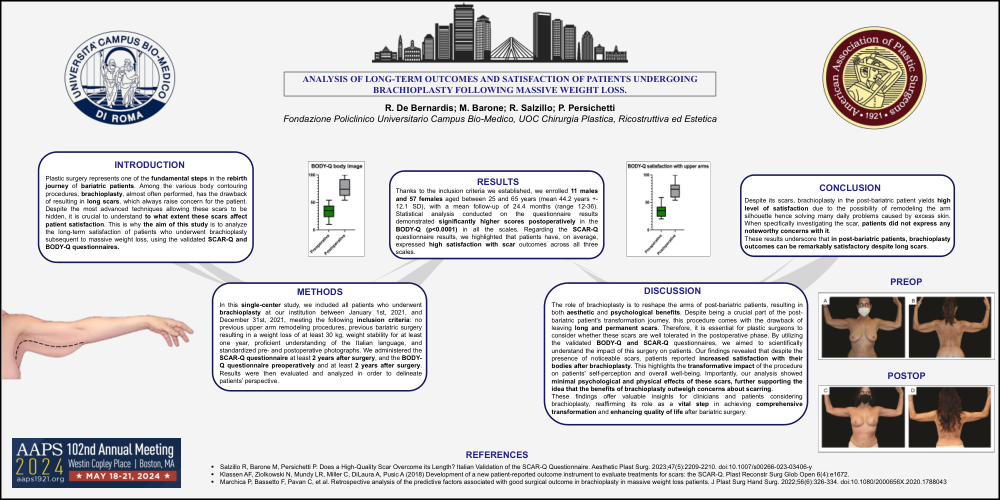
Introduction: Plastic surgery represents one of the fundamental steps in the rebirth journey of bariatric patients. Among the various body contouring procedures, brachioplasty, almost often performed, has the drawback of resulting in long scars, which always raise concern for the patient. Despite the most advanced techniques allowing these scars to be hidden, it is crucial to understand to what extent these scars affect patient satisfaction. This is why the aim of this study is to analyze the long-term satisfaction of patients who underwent brachioplasty subsequent to massive weight loss, using the validated SCAR-Q and BODY-Q questionnaires.
Methods: In this single-center study, we included all patients who underwent brachioplasty at our institution between January 1st, 2021, and December 31st, 2021, meeting the following inclusion criteria: no previous upper arm remodeling procedures, previous bariatric surgery resulting in a weight loss of at least 30 kg, weight stability for at least one year, proficient understanding of the Italian language, and standardized pre- and postoperative photographs. We administered the SCAR-Q questionnaire at least 2 years after surgery, and the BODY-Q questionnaire preoperatively and at least 2 years after surgery. Results were then evaluated and analyzed in order to delineate patients’ perspective.
Results: Thanks to the inclusion criteria we established, we enrolled 11 males and 57 females aged between 25 and 65 years (mean 44.2 years +- 12.1 SD), with a mean follow-up of 24.4 months (range 12-36). Statistical analysis conducted on the questionnaire results demonstrated significantly higher scores postoperatively in the BODY-Q (p<0.0001) in all the scales. Regarding the SCAR-Q questionnaire results, we highlighted that patients have, on average, expressed high satisfaction with scar outcomes across all three scales.
Discussion: The role of brachioplasty is to reshape the arms of post-bariatric patients, resulting in both aesthetic and psychological benefits. Despite being a crucial part of the post-bariatric patient's transformation journey, this procedure comes with the drawback of leaving long and permanent scars. Therefore, it is essential for plastic surgeons to consider whether these scars are well tolerated in the postoperative phase. By utilizing the validated BODY-Q and SCAR-Q questionnaires, we aimed to scientifically understand the impact of this surgery on patients. Our findings revealed that despite the presence of noticeable scars, patients reported increased satisfaction with their bodies after brachioplasty. This highlights the transformative impact of the procedure on patients' self-perception and overall well-being. Importantly, our analysis showed minimal psychological and physical effects of these scars, further supporting the idea that the benefits of brachioplasty outweigh concerns about scarring.These findings offer valuable insights for clinicians and patients considering brachioplasty, reaffirming its role as a vital step in achieving comprehensive transformation and enhancing quality of life after bariatric surgery.
Conclusion: Despite its scars, brachioplasty in the post-bariatric patient yields high level of satisfaction due to the possibility of remodeling the arm silhouette hence solving many daily problems caused by excess skin. When specifically investigating the scar, patients did not express any noteworthy concerns with it. These results underscore that in post-bariatric patients, brachioplasty outcomes can be remarkably satisfactory despite long scars.