203 posters, 14 topics, 5 sessions, 817 authors, 256 institutions
ePostersLive by SciGen Technologies S.A. All rights reserved.
The AAPS 102nd Annual Meeting
May 18-21, 2024 | The Westin Copley Place, Boston, MA

D144
A Return To Baseline: Superior Long-Term Patient-Reported Psychosocial Outcomes In Autologous Breast Reconstruction
Part of Topic
Breast Reconstruction
A Return To Baseline: Superior Long-Term Patient-Reported Psychosocial Outcomes In Autologous Breast Reconstruction
Introduction
•Breast sensation after postmastectomy reconstruction has become increasingly important to patients and surgeons alike, garnering attention on a national scale1.
•Our team has previously shown superior sensory recovery in autologous compared to alloplastic reconstruction2.
•However, the relationship between cutaneous breast sensation and patients’ psychosocial outcomes have not been elucidated.
•Objective: To build upon our previous work by evaluating patient-reported outcomes and cutaneous breast sensation of patients with alloplastic and autologous breast reconstruction
Methods
•Women undergoing mastectomy with immediate two-stage implant-based reconstruction or deep inferior epigastric perforator (DIEP) flap were prospectively identified
•Neurosensory testing performed preoperatively and at defined time points using a pressure-specified sensory device (Fig 2)
•BREAST-Q survey administered at defined time points. Four scales of Reconstruction Module evaluated: Psychosocial Wellbeing, Sexual Wellbeing, Satisfaction with Breasts, and Chest Wellbeing
•Sensation data and BREAST-Q scores of two reconstruction groups analyzed with Wilcox tests
Conclusion
•Both reconstruction groups had the highest threshold of cutaneous sensitivity 0-6 months after surgery with improvement over time
•Autologous reconstruction had superior cutaneous sensitivity to alloplastic reconstruction at every postoperative timepoint
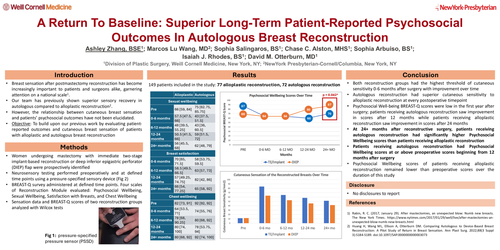
•Psychosocial Well-being BREAST-Q scores were low in the first year after surgery; patients receiving autologous reconstruction saw improvement in scores after 12 months while patients receiving alloplastic reconstruction saw improvement in scores after 24 months
•At 24+ months after reconstructive surgery, patients receiving autologous reconstruction had significantly higher Psychosocial Wellbeing scores than patients receiving alloplastic reconstruction
•Patients receiving autologous reconstruction had Psychosocial Wellbeing scores at or above preoperative scores beginning from 12 months after surgery
•Psychosocial Wellbeing scores of patients receiving alloplastic reconstruction remained lower than preoperative scores over the duration of this study