203 posters, 14 topics, 5 sessions, 817 authors, 256 institutions
ePostersLive by SciGen Technologies S.A. All rights reserved.
The AAPS 102nd Annual Meeting
May 18-21, 2024 | The Westin Copley Place, Boston, MA

D133
One And Done?: Predictors Of Revision And Additional Operations Following Two-stage Tissue Expander To Implant-based Breast Reconstruction
Poster Presenter
Part of Topic
Breast Reconstruction
BACKGROUND
Two-stage implant-based breast reconstruction (IBR) is the most commonly performed postmastectomy breast reconstructive technique. Following IBR, patients may undergo revisions and reoperation to achieve more satisfaction with their breasts or address complications. There is a paucity of literature examining factors that lead to reoperation, revision, and additional procedures following two-stage IBR
STUDY OBJECTIVES
Primary Objective: Examine variables associated with undergoing additional procedures following two-stage IBR.
Secondary Objective: Evaluate the impact of additional procedures on patient-reported outcomes after two-stage IBR.
METHODS
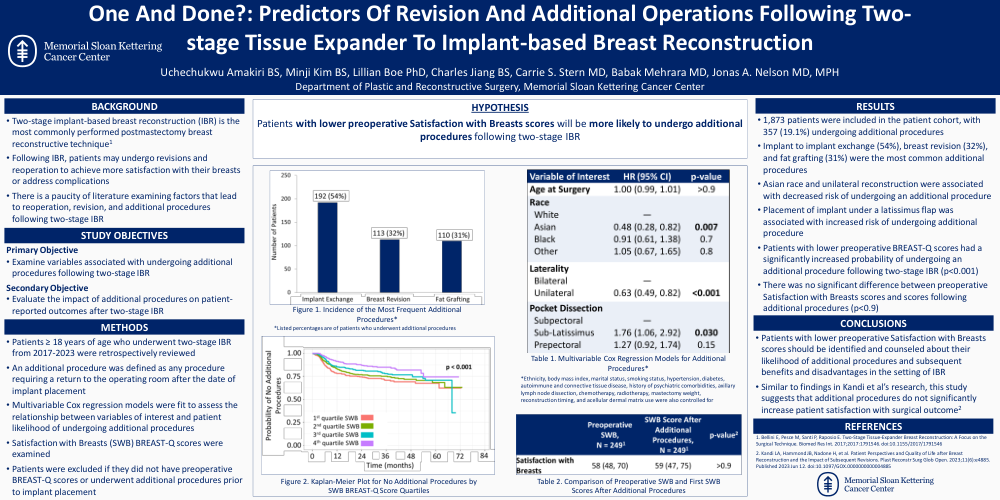
Patients ≥ 18 years of age who underwent two-stage IBR from 2017-2023 were retrospectively reviewed. An additional procedure was defined as any procedure requiring a return to the operating room after the date of implant placement. Multivariable Cox regression models were fit to assess the relationship between variables of interest and patient likelihood of undergoing additional procedures. Satisfaction with Breasts (SWB) BREAST-Q scores were examined. Patients were excluded if they did not have preoperative BREAST-Q scores or underwent additional procedures prior to implant placement.
HYPOTHESIS
Patients with lower preoperative Satisfaction with Breasts scores will be more likely to undergo additional procedures following two-stage IBR.
RESULTS
1,873 patients were included in the patient cohort, with 357 (19.1%) undergoing additional procedures. Implant to implant exchange (54%), breast revision (32%), and fat grafting (31%) were the most common additional procedures. Asian race and unilateral reconstruction were associated with decreased risk of undergoing an additional procedure. Placement of implant under a latissimus flap was associated with increased risk of undergoing additional procedure. Patients with lower preoperative BREAST-Q scores had a significantly increased probability of undergoing an additional procedure following two-stage IBR (p<0.001). There was no significant difference between preoperative Satisfaction with Breasts scores and scores following additional procedures (p<0.9).
CONCLUSIONS
Patients with lower preoperative Satisfaction with Breasts scores should be identified and counseled about their likelihood of additional procedures and subsequent benefits and disadvantages in the setting of IBR. Similar to findings in Kandi et al’s research, this study suggests that additional procedures do not significantly increase patient satisfaction with surgical outcome.