203 posters, 14 topics, 5 sessions, 817 authors, 256 institutions
ePostersLive by SciGen Technologies S.A. All rights reserved.
The AAPS 102nd Annual Meeting
May 18-21, 2024 | The Westin Copley Place, Boston, MA

D89
Nipple Areolar Malposition Versus Ideal Position After Nipple-Sparing Mastectomy Reconstruction
Poster Presenter
Authors
Alessa Mikaela Mendoza, Alex Hochwald, Zhuo Li, Sahar Borna, Antonio Forte, Brian Rinker, Sarvam TerKonda, James Jakub, Sarah McLaughlin, Olivia Ho
Affiliations
Part of Topic
Breast Reconstruction
Nipple Areolar Malposition Versus Ideal Position After Nipple-Sparing Mastectomy Reconstruction
Alessa Mikaela Mendoza, Alex Hochwald, MS, Zhuo Li, MS, Sahar Borna, MD, Antonio Forte, MD PhD, Brian Rinker, MD, Sarvam TerKonda, MD, James Jakub, MD, Sarah McLaughlin, MD, Olivia Ho, MD MMSc MPH FRCSC FACS Division of Plastic Surgery, Mayo Clinic, Jacksonville, Florida
BACKGROUND
Advances in surgical oncology care have demonstrated the safety of nipple-sparing mastectomy (NSM), which has allowed for research-proven efficacy in cancer ablation while also having reconstruction aesthetic benefit1,2. Nipple-sparing mastectomy reconstruction also provides location improvement in post-reconstruction quality of life in comparison to non-nipple- sparing mastectomy reconstruction3. As with any surgery, however, there are possible complications, and one of the most challenging to resolve is nipple malposition, in which the nipples diverge from the original or ideal positioning.
OBJECTIVES
UNDERSTANDING MALPOSITION
This retrospective study aims to understand nipple- areolar complex (NAC) malposition in nipple-sparing mastectomy reconstruction patients.
IDENTIFYING CONTRIBUTING FACTORS
We also hope to identify potential surgical techniques that either increase or decrease the likelihood of NAC malposition to improve surgical standards of care and to achieve better patient outcomes.
METHODS
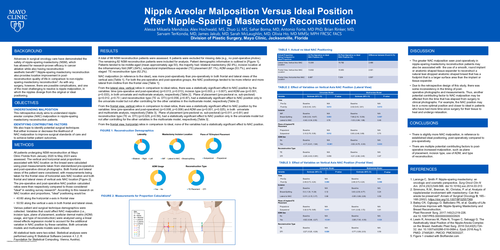
All patients undergoing NSM reconstruction at Mayo Clinic Florida from January 2020 to May 2023 were assessed. The vertical and horizontal axial proportions associated with NAC location on the breast were calculated using pixel measurements taken from standardized pre-operative and post-operative clinical photographs. Both frontal and lateral views of the patient were considered, with measurements being taken for the frontal view of horizontal axis NAC location and both frontal and lateral views of vertical axis NAC location [Figure 2].
The pre-operative and post-operative NAC position calculated ratios were then respectively compared to those considered "ideal" in existing survey research4. According to this research on NAC location and proportions, "ideal" positioning would be:
• 40:60alongthehorizontalx-axisinfrontalview
• 50:50alongtheverticalx-axisinbothfrontalandlateralviews.
Various patient and surgical technique demographics were collected. Variables that could affect NAC malposition (i.e., incision type, plane of placement, acellular dermal matrix (ADM) usage, and type of reconstruction) were analyzed using a linear mixed effects regression model to account for the additional variation in NAC position by these variables. Both univariate models and multivariate models were utilized.
All statistical tests were two-sided. Statistical analyses were performed using R Statistical Software (version 4.1.2; R Foundation for Statistical Computing, Vienna, Austria).
RESULTS
A total of 88 NSM reconstruction patients were assessed. 6 patients were excluded for missing data (e.g., no post-operative photos). The remaining 82 NSM reconstruction patients were included for analysis. Patient demographic information is outlined in [Figure 1]. Patients tended to be middle-aged (mean approximately age 50), the majority had: bilateral mastectomy (82.9%), incision location at the inframammary fold (IMF) (64%), subpectoral implant/tissue expander (TE) placement (67.1%), ADM usage (53.7%), and were staged TE reconstruction type (62.2%).
NAC malposition (in reference to the ideal), was more post-operatively than pre-operatively in both frontal and lateral views of the vertical axis [Table 1]. For both the pre-operative and post-operative groups, the NAC positionings tended to be more inferior and more lateral from midline from the frontal view [Table 1].
From the lateral view, vertical ratios in comparison to ideal ratios, there was a statistically significant effect to NAC position by the variables: time (pre-operative and post-operative) (p=0.013, p=0.013), incision type (p=0.003, p = 0.007), and ADM use (p<0.001, p=0.033), in both univariate and multivariate analysis, respectively [Table 2]. Plane of placement (pre-pectoral vs. sub-pectoral) (p=0.012, p=0.70 ) and reconstruction type (TE vs. DTI) (p=0.058, p=0.87), had a statistically significant effect to NAC position only in the univariate model but not after controlling for the other variables in the multivariate model, respectively [Table 2]
From the frontal view, vertical ratios in comparison to ideal ratios, there was a statistically significant effect to NAC position by the variables: time (pre-operative and post-operative) (p=0.006, p=0.006) and ADM use (p<0.001, p=0.025), in both univariate
and multivariate analysis, respectively [Table 3]. Plane of placement (pre-pectoral vs. sub-pectoral) (p=0.011, p=0.81) and reconstruction type (TE vs. DTI) (p=0.029, p=0.59), had a statistically significant effect to NAC position only in the univariate model but not after controlling for the other variables in the multivariate model, respectively [Table 3] .
From the frontal view, horizontal ratios in comparison to ideal, none of the variables had a statistically significant effect to NAC position.
DISCUSSION
The greater NAC malposition seen post-operatively in nipple-sparing mastectomy reconstruction patients may also be associated with the use of a smooth, round implant or anatomic shaped tissue expander to reconstruct a natural tear-dropped anatomic shaped breast that has a footprint that is a larger surface area than the implant or tissue expander.
Due to the retrospective design of this study, there was some inconsistency in the timing of post-operative photographs and measurements. Thus, another potential contributing factor to NAC malposition may be affected from the time that has elapsed from surgery to clinical photographs. For example, the NAC position may be in a more optimal position and closer to ideal in patients who have had more time since surgery for their tissue to heal and undergo relaxation.
CONCLUSIONS
-
There is slightly more NAC malposition, in reference to established ideal positioning, post-operatively compared to pre-operatively.
-
There are multiple potential contributing factors to post- operative increased malposition, such as plane of placement, incision type, use of ADM, and type
of reconstruction.
-
Laronga C, Smith P. Nipple-sparing mastectomy: an oncologic and cosmetic perspective. Surg Oncol Clin N Am. 2014;23(3):549-566. doi:10.1016/j.soc.2014.03.013
-
Simmons, R.M., Brennan, M., Christos, P. et al. Analysis of nipple/areolar involvement with mastectomy: Can the areola be preserved? Annals of Surgical Oncology 9, 165– 168 (2002). https://doi.org/10.1007/BF02557369
-
Bailey CR, Ogbuagu O, Baltodano PA, et al. Quality-of-Life Outcomes Improve with Nipple-Sparing Mastectomy and Breast Reconstruction.
Plast Reconstr Surg. 2017;140(2):219-226. doi:10.1097/PRS.0000000000003505 -
Lewin R, Amoroso M, Plate N, Trogen C, Selvaggi G. The Aesthetically Ideal Position of the Nipple-Areola Complex on the Breast. Aesthetic Plast Surg. 2016 Oct;40(5):724- 32. doi: 10.1007/s00266-016-0684-z. Epub 2016 Aug 5. PMID: 27495261; PMCID: PMC5030227.
-
Figure 1 created with BioRender.com