203 posters, 14 topics, 5 sessions, 817 authors, 256 institutions
ePostersLive by SciGen Technologies S.A. All rights reserved.
The AAPS 102nd Annual Meeting
May 18-21, 2024 | The Westin Copley Place, Boston, MA

D83
A Comparison Of Postoperative Outcomes Based On Recipient Vessels In Scalp Free Flap Reconstruction: A Systematic Review And Meta-analysis
Part of Topic
Outcomes
A Comparison Of Postoperative Outcomes Based On Recipient Vessels In Scalp Free Flap Reconstruction: A Systematic Review And Meta-analysis
Asli Pekcan, BS; Idean Roohani, BS; Deborah Choe, BA; Micaela Tomaro, BS; Ishani Premaratne, MD; Langley G. Wallace, BA; Joseph N. Carey, MD; David A. Daar, MD
Background
•Scalp reconstruction presents unique challenges due to the scalp’s distinct anatomical, physiologic, and aesthetic characteristics
•Recipient vessel selection is a critical aspect of scalp reconstruction, with the most utilized vessels being the superficial temporal artery (STA) and facial artery (FA)
•The decision between recipient vessels considers several factors, including vessel caliber, accessibility, and reconstructive goals
•This systematic review addresses a critical gap in the literature regarding the impact of recipient vessel selection on post-operative outcomes following scalp reconstruction
Methods
•The following databases were utilized:
•PubMed, Scopus, Embase, Web of Science, Cochrane, and Medline
•Studies reporting outcomes of scalp reconstruction using either the STA or FA were identified
•Exclusion criteria consisted of non-English language articles, systematic reviews/case series’ with <6 patients, non-scalp reconstruction studies, and animal studies
•Recipient vessel and outcomes of interest, including flap loss, partial flap necrosis, wound dehiscence, venous thrombosis, and infection rates were collected
•Quality evaluation was performed using ASPS criteria and the ROBINS-I tool
Results
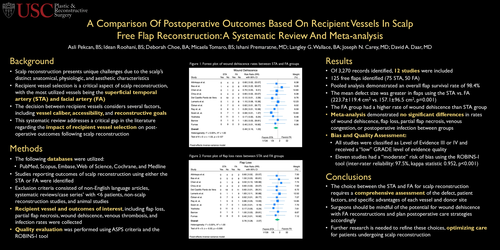
•Of 3,270 records identified, 12 studies were included
•125 free flaps identified (75 STA, 50 FA)
•Pooled analysis demonstrated an overall flap survival rate of 98.4%
•The mean defect size was greater in flaps using the STA vs. FA (223.7±119.4 cm2 vs. 157.1±96.5 cm2, p=0.001)
•The FA group had a higher rate of wound dehiscence than STA group
•Meta-analysis demonstrated no significant differences in rates of wound dehiscence, flap loss, partial flap necrosis, venous congestion, or postoperative infection between groups
•Bias and Quality Assessment:
•All studies were classified as Level of Evidence III or IV and received a “low” GRADE level of evidence quality
•Eleven studies had a “moderate” risk of bias using the ROBINS-I tool (inter-rater reliability: 97.5%, kappa statistic 0.952, p<0.001)
Conclusions
•The choice between the STA and FA for scalp reconstruction requires a comprehensive assessment of the defect, patient factors, and specific advantages of each vessel and donor site
•Surgeons should be mindful of the potential for wound dehiscence with FA reconstructions and plan postoperative care strategies accordingly
•Further research is needed to refine these choices, optimizing care for patients undergoing scalp reconstruction