203 posters, 14 topics, 5 sessions, 817 authors, 256 institutions
ePostersLive by SciGen Technologies S.A. All rights reserved.
The AAPS 102nd Annual Meeting
May 18-21, 2024 | The Westin Copley Place, Boston, MA

D82
Improving Reconstructive Outcomes Of Female Peri-pelvic Oncologic Defects
Poster Presenter
Authors
Ashley Shin, Rami Elmorsi, Christopher Nguyen, Jessie Yu, David Baumann, Margaret S. Roubaud
Affiliations
University of Texas Health Science Center at Houston McGovern Medical School, McGovern Medical School at UTHealth Houston, Houston, TX, USA, Department of Plastic & Reconstructive Surgery, The University of Texas MD Anderson Cancer Center, Houston, TX, USA
Part of Topic
Outcomes
Improving Reconstructive Outcomes Of Female Peripelvic Oncologic Defects
Ashley Shin BS1, Rami Elmorsi MD2, Christopher Nguyen MD2, Jessie Yu MD2, David Baumann MD2, Margaret S. Roubaud, MD2
1McGovern Medical School at UTHealth Houston, Houston, TX, USA
2Department of Plastic & Reconstructive Surgery, The University of Texas MD Anderson Cancer Center, Houston, TX, USA
Purpose
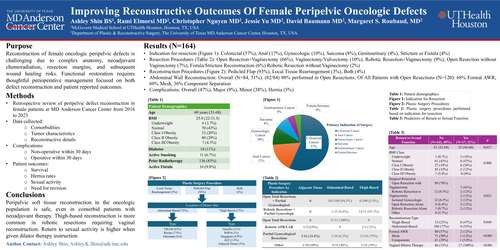
Reconstruction of female oncologic peripelvic defects is challenging due to complex anatomy, neoadjuvant chemoradiation, resection margins, and subsequent wound healing risks. Functional restoration requires thoughtful perioperative management focused on both defect reconstruction and patient reported outcomes.
Methods
Results (N=164)
Conclusions
Peripelvic soft tissue reconstruction in the oncologic population is safe, even in comorbid patients with neoadjuvant therapy. Thigh-based reconstruction is more common in robotic resections requiring vaginal reconstruction. Return to sexual activity is higher when given dilator therapy instruction.