203 posters, 14 topics, 5 sessions, 817 authors, 256 institutions
ePostersLive by SciGen Technologies S.A. All rights reserved.
The AAPS 102nd Annual Meeting
May 18-21, 2024 | The Westin Copley Place, Boston, MA

D64
Reevaluating Hemoglobin A1c And Other Factors As Preoperative Risk Stratifiers Of Autologous And Alloplastic Breast Reconstruction: A Receiver Operative Characteristic Curve Analysis Of National NSQIP Data
Poster Presenter
Part of Topic
Breast Reconstruction
What’s the Threshold? Investigating Body Mass Index & Hemoglobin A1C Cutoff Values for Complication Risk in Breast Reconstruction With NSQIP
Author list: Caroline C. Bay, BA1; Robert E. George, MD1; Madeline G. Chin, BA2; Sarah M. Thornton, BA1; Steven P. Moura, MA1; Samuel O. Poore, MD, PhD1
1. Division of Plastic and Reconstructive Surgery, Department of Surgery, University of Wisconsin - Madison, Madison, WI
2. Division of Plastic Surgery, Department of Surgery, Brown University, Providence, RI
Background
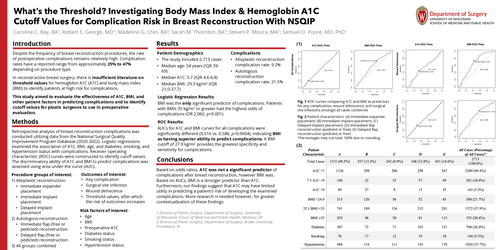
Despite the frequency of breast reconstruction procedures, the rate of postoperative complications remains relatively high. Complication rates have a reported range from approximately 25% to 47% depending on procedure type. In reconstructive breast surgery, there is insufficient literature on threshold values for hemoglobin A1C (A1C) and body mass index (BMI) to identify patients at high risk for complications. This study aimed to evaluate the effectiveness of A1C, BMI, and other patient factors in predicting complications and to identify cutoff values for plastic surgeons to use in preoperative evaluation.
Methods
Retrospective analysis of breast reconstruction complications was conducted utilizing data from the National Surgical Quality Improvement Program Database (2020-2022). Logistic regressions examined the association of A1C, BMI, age, and diabetes, smoking, and hypertension status with complications. Receiver operating characteristic curves were constructed to identify cutoff values. The discriminatory ability of A1C and BMI to predict complications was assessed using area under the curve (AUC).
Results
The study included 2,713 cases. BMI was the only significant predictor of complications. Patients with BMIs 35 kg/m2 or greater had the highest odds of complications (OR 2.060, p<0.001). AUCs for A1C and BMI curves for all complications were significantly different (0.516 vs. 0.586, p < 0.0004), indicating BMI as having superior ability to predict complications. A BMI cutoff of 27.9 kg/m2 provides the greatest specificity and sensitivity for complications.
Conclusions
Based on odds ratios, A1C was not a significant predictor of complications after breast reconstruction, however BMI was. Based on AUCs, BMI is a stronger predictor than A1C. Furthermore, our findings suggest that A1C may have limited utility in predicting a patient’s risk of developing the examined complications. More research is needed however, for greater contextualization of these findings.