203 posters, 14 topics, 5 sessions, 817 authors, 256 institutions
ePostersLive by SciGen Technologies S.A. All rights reserved.
The AAPS 102nd Annual Meeting
May 18-21, 2024 | The Westin Copley Place, Boston, MA

D46
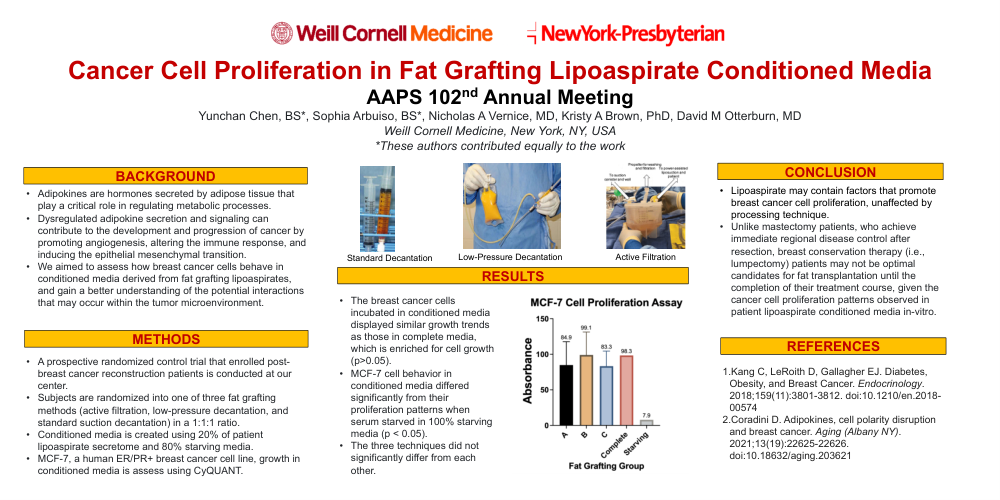
Breast Cancer Cell Proliferation In Fat Grafting Lipoaspirate Conditioned Media
Poster Presenter
Authors
Yunchan Chen, Sophia Arbuiso, Nicholas A Vernice, Kristy A Brown, David M Otterburn
Affiliations
Part of Topic
Basic Science Research
PURPOSE: Adipokines are hormones secreted by adipose tissue that play a critical role in regulating metabolic processes. Dysregulated adipokine secretion and signaling can contribute to the development and progression of cancer by promoting angiogenesis, altering the immune response, and inducing the epithelial mesenchymal transition. We aimed to assess how breast cancer cells behave in conditioned media derived from fat grafting lipoaspirates, and gain a better understanding of the potential interactions that may occur within the tumor microenvironment.
METHODS: A prospective randomized control trial that enrolled post-breast cancer reconstruction patients is conducted at our center. Subjects are randomized into one of three fat grafting methods (active filtration, low pressure decantation, and standard suction decantation) in a 1:1:1 ratio. Conditioned media is created using 20% of patient lipoaspirate secretome and 80% starving media. MCF-7, a human ER/PR+ breast cancer cell line, growth in conditioned media is assess using CyQUANT.
RESULTS: The breast cancer cells incubated in conditioned media displayed similar growth trends as those in complete media, which is enriched for cell growth (p>0.05). MCF-7 cell behavior in conditioned media differed significantly from their proliferation patterns when serum starved in 100% starving media (p < 0.05). The three techniques did not significantly differ from each other.
CONCLUSION: Unlike mastectomy patients, who achieve immediate regional disease control after resection, breast conservation therapy (i.e., lumpectomy) patients may not be optimal candidates for fat transplantation until the completion of their treatment course, given the cancer cell proliferation patterns observed in patient lipoaspirate conditioned media in-vitro.