212 posters, 10 topics, 5 sessions, 754 authors, 237 institutions
ePostersLive by SciGen Technologies S.A. All rights reserved.
The AAPS 101st Annual Meeting
29 April – 2 May, 2023 | Chicago, IL

PC47
Physiologic Effects Of Thoracic Duct Lymphovenous Bypass
Poster Presenter
Part of Topic
Outcomes
Introduction
•Surgical intervention for lymphatic pathology remains largely unexplored, but thoracic duct mechanical obstruction is an exception which may be addressed with microsurgery.
•Patients who failed conservative treatment and minimally invasive therapies may be candidates for microsurgical lymphovenous bypass. We have developed a multidisciplinary, collaborative intraoperative protocol with interventional radiologists.
•Postoperatively, lymphovenous bypass is thought to cause physiological derangements as a result of the increased venous return, but no data exist on specifically what changes can be expected.
Purpose
We herein report on a case series of thoracic duct lymphovenous bypass patients and their postoperative physiologic changes.
Methods
•Retrospective review of all nonsyndromic adult patients who underwent thoracic duct lymphovenous bypass by the senior authors from 2016-2022
•Demographic and perioperative data; postoperative changes in vital signs including oxygen requirements, heart rate (HR), and blood pressure were collected.
Results
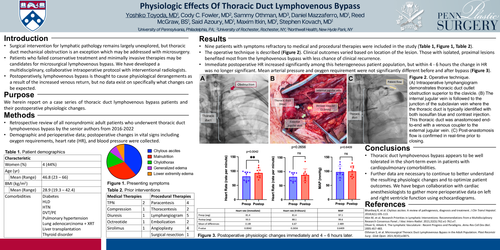
•Nine patients with symptoms refractory to medical and procedural therapies were included in the study (Table 1, Figure 1, Table 2).
•The operative technique is described (Figure 2). Clinical outcomes varied based on location of the lesion. Those with isolated, proximal lesions benefited most from the lymphovenous bypass with less chance of clinical recurrence.
•Immediate postoperative HR increased significantly among this heterogeneous patient population, but within 4 - 6 hours the change in HR was no longer significant. Mean arterial pressure and oxygen requirement were not significantly different before and after bypass (Figure 3).
Conclusions
•Thoracic duct lymphovenous bypass appears to be well tolerated in the short-term even in patients with cardiopulmonary comorbidities.
•Further data are necessary to continue to better understand the resulting physiologic changes and to optimize patient outcomes. We have begun collaboration with cardiac anesthesiologists to gather more perioperative data on left and right ventricle function using echocardiograms.