212 posters, 10 topics, 5 sessions, 754 authors, 237 institutions
ePostersLive by SciGen Technologies S.A. All rights reserved.
The AAPS 101st Annual Meeting
29 April – 2 May, 2023 | Chicago, IL

D138
A 28-year Single Institutional Experience Of Complete Reduction Of Extremity Lymphedema Using Suction Assisted Lipectomy
Poster Presenter
Authors
Affiliations
Part of Topic
Outcomes
A 28-year Single Institutional Experience of Complete Reduction of Extremity Lymphedema Using Suction Assisted Lipectomy
HÅKAN BRORSON, M.D., PH.D., DEPARTMENT OF CLINICAL SCIENCES IN MALMÖ, LUND UNIVERSITY, PLASTIC AND RECONSTRUCTIVE SURGERY, SKÅNE UNIVERSITY HOSPITAL, MALMÖ, SWEDEN
Email: hakan.brorson@med.lu.se Cellular: +46-706-463838
Conclusion
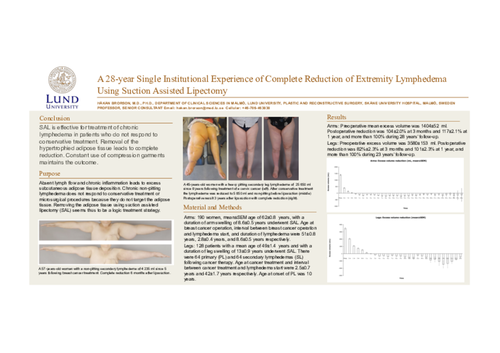
SAL is effective for treatment of chronic lymphedema in patients who do not respond to conservative treatment. Removal of the hypertrophied adipose tissue leads to complete reduction. Constant use of compression garments maintains the outcome.
Purpose
Absent lymph flow and chronic inflammation leads to excess subcutaneous adipose tissue deposition. Chronic non-pitting lymphedema does not respond to conservative treatment or microsurgical procedures because they do not target the adipose tissue. Removing the adipose tissue using suction assisted lipectomy (SAL) seems thus to be a logic treatment strategy.
Material and Methods
Arms: 190 women, mean±SEM age of 62±0.8 years, with a duration of arm swelling of 8.6±0.5 years underwent SAL. Age at breast cancer operation, interval between breast cancer operation and lymphedema start, and duration of lymphedema were 51±0.8 years, 2.8±0.4 years, and 8.6±0.5 years respectively.
Legs: 128 patients with a mean age of 49±1.4 years and with a duration of leg swelling of 13±0.9 years underwent SAL. There were 64 primary (PL) and 64 secondary lymphedemas (SL) following cancer therapy. Age at cancer treatment and interval between cancer treatment and lymphedema start were 2.5±0.7 years and 42±1.7 years respectively. Age at onset of PL was 10 years.
Results
Arms: Preoperative mean excess volume was 1404±52 ml. Postoperative reduction was 104±2.0% at 3 months and 117±2.1% at 1 year, and more than 100% during 28 years’ follow-up.
Legs: Preoperative excess volume was 3580±153 ml. Postoperative reduction was 82%±2.3% at 3 months and 101±2.3% at 1 year, and more than 100% during 23 years’ follow-up.