212 posters, 10 topics, 5 sessions, 754 authors, 237 institutions
ePostersLive by SciGen Technologies S.A. All rights reserved.
The AAPS 101st Annual Meeting
29 April – 2 May, 2023 | Chicago, IL

PC42
The Epidemiology Of Postoperative Catastrophic Health Expenditure In The United States
Poster Presenter
Authors
Ali Rae, Anam Ehsan, Alan Yang, Hannah Gilder, Niteesh Choudhary, Justin Dimick, Marcella Aslan, Andrea Pusic, Chuan-Chin Huang, Kavitha Ranganathan
Affiliations
Oregon Health & Sciences University, Department of Neurosurgery, Oregon Health & Science University & Program in Global Surgery and Social Change, Harvard Medical School, Brigham and Women's Hospital, Harvard Medical School, Program in Global Surgery and Social Change, Harvard Medical School, Department of Plastic and Reconstructive Surgery, Brigham and Women's Hospital, Harvard Medical School
Part of Topic
Outcomes
Introduction
Gap in Knowledge:
Study Aims:
1. Quantify the epidemiological burden of postoperative CHE in surgical patients.
2. Identify risk factors for CHE among surgical patients.
Methods
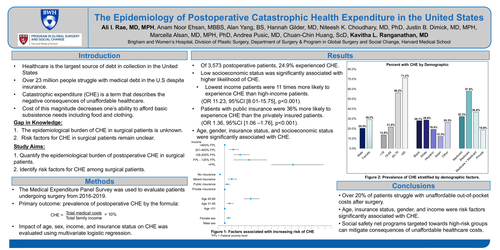
(OR 11.23, 95%CI [8.01-15.75], p<0.001).
(OR 1.36, 95%CI [1.06 –1.76], p<0.001).
Over 20% of patients struggle with unaffordable out-of-pocket costs after surgery.
Age, insurance status, gender, and income were risk factors significantly associated with CHE.
Social safety net programs targeted towards high-risk groups can mitigate consequences of unaffordable healthcare costs.