212 posters, 10 topics, 5 sessions, 754 authors, 237 institutions
ePostersLive by SciGen Technologies S.A. All rights reserved.
The AAPS 101st Annual Meeting
29 April – 2 May, 2023 | Chicago, IL

D164
Identifying Independent Predictors Of Postoperative Morbidity In Patients Undergoing Cranioplasty: A NSQIP Analysis
Poster Presenter
Part of Topic
Outcomes
As health systems shift towards value-based models, it is vital that preoperative risk management is optimized to prevent adverse outcomes. Previous research has identified a complication rate of 27.4% in cranioplasty, necessitating the characterization of risk factors.1 The present study intends to identify independent predictors of postoperative complications and health utilization in patients undergoing cranioplasty.
The American College of Surgeon’s National Surgery Quality Improvement Project (NSQIP) database was queried for patients who underwent cranioplasty from 2011-2020 using CPT codes (62140, 62141, 62143, 62145, 62146, 62147). Demographic, clinical, and intraoperative characteristics were collected for each patient. The outcomes analyzed were ≥1 medical or wound complication, unplanned reoperation, and extended hospital stay (>30 days). Patients missing any of the characteristics studied were excluded from the study sample.
Bivariate analyses, including Fisher’s exact test and independent, two-tailed Welch’s t-tests, were used to identify variables that were associated with risk of these adverse outcomes. Any variable that yielded a p-value less than 0.2 upon bivariate analysis was included in a subsequent multivariate logistic regression to identify independent predictors of the aforementioned outcomes.
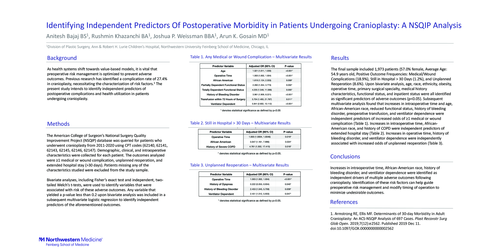
The final sample included 1,973 patients (57.0% female, Average Age: 54.9 years old, Positive Outcome Frequencies: Medical/Wound Complications (18.9%), Still in Hospital > 30 Days (1.2%), and Unplanned Reoperation (8.6%). Upon bivariate analysis, age, race, ethnicity, obesity, operative time, primary surgical specialty, medical history characteristics, functional status, and inpatient status were all identified as significant predictors of adverse outcomes (p<0.05). Subsequent multivariate analysis found that increases in intraoperative time and age, African-American race, reduced functional status, history of bleeding disorder, preoperative transfusion, and ventilator dependence were independent predictors of increased odds of ≥1 medical or wound complication (Table 1). Increases in intraoperative time, African-American race, and history of COPD were independent predictors of extended hospital stay (Table 2). Increases in operative time, history of bleeding disorder, and ventilator dependence were independently associated with increased odds of unplanned reoperation (Table 3).
Increases in intraoperative time, African-American race, history of bleeding disorder, and ventilator dependence were identified as independent drivers of multiple adverse outcomes following cranioplasty. Identification of these risk factors can help guide preoperative risk management and modify timing of operation to minimize undesirable outcomes.