212 posters, 10 topics, 5 sessions, 754 authors, 237 institutions
ePostersLive by SciGen Technologies S.A. All rights reserved.
The AAPS 101st Annual Meeting
29 April – 2 May, 2023 | Chicago, IL

D67
Functional Outcomes Following Microsurgical Thoracic Duct Lymphovenous Bypass
Poster Presenter
Authors
Affiliations
Part of Topic
Outcomes
Functional Outcomes Following Microsurgical Thoracic Duct Lymphovenous Bypass
INTRODUCTION
§The thoracic duct (TD) is the primary lymphatic conduit of the body and courses intrathoracically, originating from the cisterna chyli in the abdomen and draining into the left subclavian vein
§Central lymphatic obstruction can occur when the TD becomes occluded secondary to trauma, neckinstrumentation, or congenital deformities
§TD occlusion is highly morbid, leading to chylous effusions, chylous ascites, and lymphedema
§TD bypass has emerged as treatment for refractory cases, but functional outcomes remain unknown1-4
METHODS
§A retrospective review of all nonsyndromic patients undergoing TD bypass between 2019-2022 at the University of Pennsylvania was performed.
§All cases were performed with intraoperative
lymphangiography by interventional radiology.
lymphangiography by interventional radiology.
§Surgical details were collected from operative logs
§Preoperative functional status was determined at the baseline preoperative visit
§Postoperative function was compared to baseline presentation at the time of initial evaluation at two months.
RESULTS
§A retrospective review of all nonsyndromic patients undergoing TD bypass between 2019-2022 at the University of Pennsylvania was performed.
§All cases were performed with intraoperative
lymphangiography by interventional radiology.
lymphangiography by interventional radiology.
§Surgical details were collected from operative logs
§Preoperative functional status was determined at the baseline preoperative visit
§Postoperative function was compared to baseline presentation at the time of initial evaluation at two months.
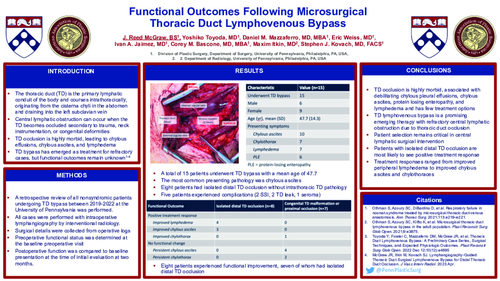
§Eight patients experienced functional improvement, seven of whom had isolated distal TD occlusion
CONCLUSIONS
§TD occlusion is highly morbid, associated with debilitating chylous pleural effusions, chylous ascites, protein losing enteropathy, and lymphedema and has few treatment options
§TD lymphovenous bypass is a promising emerging therapy with refractory central lymphatic obstruction due to thoracic duct occlusion
§Patient selection remains critical in central lymphatic surgical intervention
§Patients with isolated distal TD occlusion are most likely to see positive treatment response
§Treatment responses ranged from improved peripheral lymphedema to improved chylous ascites andchylothoraces