212 posters, 10 topics, 5 sessions, 754 authors, 237 institutions
ePostersLive by SciGen Technologies S.A. All rights reserved.
The AAPS 101st Annual Meeting
29 April – 2 May, 2023 | Chicago, IL

D66
Speech Outcomes For Cleft Lip/Palate: Results From A Multi-Center Learning Health Network
Poster Presenter
Authors
Kristina Dunworth, Amanda Del Risco, Denisse Porras Fimbres, Alexander Allori
Affiliations
Duke University School of Medicine, Duke University School of Medicine; Durham, NC, USA, Division of Plastic, Maxillofacial, and Oral Surgery; Department of Surgery; Duke University Health System; Durham, NC, USA
Part of Topic
Outcomes
Speech Outcomes For Cleft Lip/Palate: Results From A Multi-Center Learning Health Network
PURPOSE:
Multi-center networks have gained attention for facilitating research of chronic conditions, such as cleft lip/palate. Inspired by this movement, several hospitals banded together to form the Allied Cleft & Craniofacial Quality-Improvement and Research Network (ACCQUIREnet). This network prospectively collects standardized outcomes measures and stores the data in a condition-specific registry. Here, we assess the ability of this registry to compare outcomes by (1) age, (2) cleft phenotype, and (3) treatment center - focusing on speech, as an example.
BACKGROUND:
ACCQUIREnet is a Learning Health Network (LHN) designed to improve care and facilitate research of cleft lip/palate. The network collaborates to contribute to and house a cleft-specific registry of short- and long-term outcomes data intended to support robust multicenter outcomes research. Data are systematically collected according to a standardized protocol outlined by the International Consortium of Health Outcomes Measures in their “Standard Set” of cleft-patient-centered outcomes measures. The registry collects data on many outcome domains including appearance, oral health, major surgical complications, and many others.
In this pilot project, we explored the speech domain as an example to evaluate the registry’s ability to answer meaningful questions about cleft care. Specifically, we predicted that the registry would be able to compare outcomes by (1) age, (2) cleft phenotype, and (3) treatment center.
METHODS:
Data were collected prospectively during routine patient appointments at 4 cleft treatment centers between 2019-2021. The sample included non-syndromic, English-speaking children with the following cleft phenotypes: cleft lip with/without cleft alveolus (CL±A); unilateral and bilateral cleft lip, alveolus, and palate (uCLAP and bCLAP); and cleft palate (CP). Primary outcomes are described in Table 1. Median outcome scores were compared among cross-sections based on age, phenotype, and treatment center.
RESULTS:
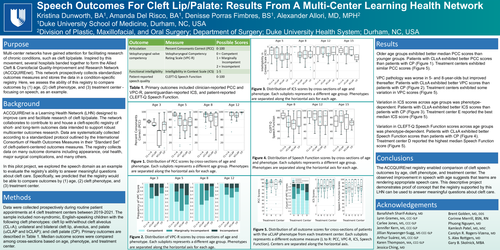
Older age groups exhibited better median PCC scores than younger groups. Patients with CL±A exhibited better PCC scores than patients with CP (Figure 1). Treatment centers exhibited similar PCC scores (Figure 5).
VPC pathology was worse in 5- and 8-year-olds but improved thereafter. Patients with CL±A exhibited better VPC scores than patients with CP (Figure 2). Treatment centers exhibited some variation in VPC scores (Figure 5).
Variation in ICS scores across age groups was phenotype-dependent. Patients with CL±A exhibited better ICS scores than patients with CP (Figure 3). Treatment center E reported the best median ICS score (Figure 5).
Variation in CLEFT-Q Speech Function scores across age groups was phenotype-dependent. Patients with CL±A exhibited better Speech Function scores than patients with CP (Figure 4). Treatment center D reported the highest median Speech Function score (Figure 5).
CONCLUSIONS:
The ACCQUIREnet registry enabled comparison of cleft speech outcomes by age, cleft phenotype, and treatment center. The observed improvement in speech with age suggests that teams are rendering appropriate speech care. This descriptive project demonstrates proof of concept that the registry supported by this LHN can be used to answer meaningful questions about cleft care.
ACKNOWLEDGEMENTS:
Banafsheh Sharif-Askary, md
Lynn Grames, ma, ccc-slp
Carlee Jones, ms, ccc-slp
Jennifer Kern, ms, ccc-slp
Jillian Nyswonger-Sugg, ms ccc-slp
Arthur Suárez, ms, ccc-slp
Karen Thompson, ma, ccc-slp
Jessica Ching, md
Brent Golden, md, dds
Corinne Merrill, BSN, RN
Phuong Nguyen, md
Kamlesh Patel, md, msc
Carolyn R. Rogers-Vizena, md
S. Alex Rottgers, md
Gary B. Skolnick, MBA