212 posters, 10 topics, 5 sessions, 754 authors, 237 institutions
ePostersLive by SciGen Technologies S.A. All rights reserved.
The AAPS 101st Annual Meeting
29 April – 2 May, 2023 | Chicago, IL

D59
Role Of Safety Limits To Tissue Resection Weight In Adolescent Reduction Mammaplasty
Poster Presenter
Authors
Salomon Puyana, H. Harvak Hajebian, Natalia Mejia, Taruni Kumar, Abigail Chaffin, Christopher Babycos, Michael Friel
Affiliations
Tulane University, Div. of Plastic Surgery, Dept. of Surgery, Tulane University School of Medicine, Dept. of Surgery, Garnet Health Medical Center, CES University, Dept. of Plastic Surgery, Ochsner Medical Center, 4Dept. of Plastic Surgery, Ochsner Medical Center
Part of Topic
Aesthetic Breast/Body Contouring
Introduction
Reduction mammaplasty (RM) is the gold-standard treatment for symptomatic macromastia,however complications related to wound healing are common.1
The literature reports high tissue resection weight (TRW), ranging from >700 g to >1500 g per breast as a significant risk factor,2-6 yet the available data islargely based on adult and middle-aged patients.
This study aims to analyze TRW as a risk factor for wound healing complications in adolescent RM
Methods
Retrospective chart review of RM cases performed between the years 2014 to 2021.
Inclusion criteria:
-10 to 24 years old
-Treatment for symptomatic macromastia only
-No previous breast surgery, radiation, or biopsy
-Wise pattern with inferior pedicle
Data collected from post-op visits at 1 week, 3 months, and 6 months postoperatively
Discussion
Increased BMI and current/former smoking status are the most recognized risk factors for wound healing complications, with wound dehiscence being the most common.2-7
The physiologic effects of obesity and tobacco smoke are known to result in vascular insufficiency, oxidative stress, alteration in immune mediators, and nutritional deficiencies
The current literature is unclear on the role of safety limits to TRW.2-7
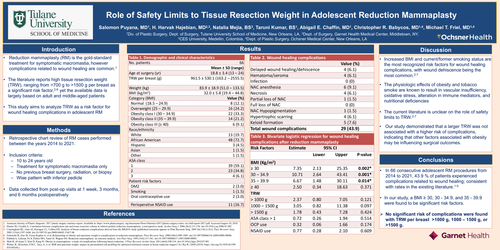
Our study demonstrated that a larger TRW was not associated with a higher risk of complications, indicating that other factors associated with obesity may be influencing surgical outcomes.
Conclusions
In 66 consecutive adolescent RM procedures from 2014 to 2021, 43.9 % of patients experienced complications related to wound healing; consistent with rates in the existing literature.1-5
In our study, a BMI ≥ 30, 30 - 34.9, and 35 - 39.9 were found to be significant risk factors.