212 posters, 10 topics, 5 sessions, 754 authors, 237 institutions
ePostersLive by SciGen Technologies S.A. All rights reserved.
The AAPS 101st Annual Meeting
29 April – 2 May, 2023 | Chicago, IL

D42
The Impact Of Body Mass Index On Surgical And Aesthetic Outcomes In Cosmetic Abdominoplasty
Part of Topic
Aesthetic Breast/Body Contouring
The Impact Of Body Mass Index On Surgical And Aesthetic Outcomes In Cosmetic Abdominoplasty
Introduction:It can be a struggle (and somewhat of a paradox) for obese patients seeking abdominoplasty to lose weight, because some surgeons won’t operate on them until they lose weight first. This is because obesity is widely thought to be a risk factor for post-operative complications. However, there is conflicting literature regarding the impact of BMI and the associated risk in body contouring procedures.
Objectives: To elucidate the risk of surgical and cosmetic complications of cosmetic abdominoplasty in overweight and obese patients.
Methods: This was a retrospective, single surgeon study, for patients who underwent cosmetic abdominoplasty from 2015 to 2021. Cosmetic abdominoplasty was defined as abdominal contouring procedure, frequently including liposuction, or rectus abdominis plication, that was not due to massive weight loss or bariatric surgery. Patients were stratified by BMI categories of normal weight, overweight, and obese. Primary Outcomes: surgical site occurrences (SSO) and cosmetic complaints (CC) as composite variables. Secondary Outcomes: surgical complications that led to reoperations, and unsatisfactory cosmetic complaints that led to revisions. Univariate and multivariate logistic regression were used to assess the risk of BMI on clinical outcomes.
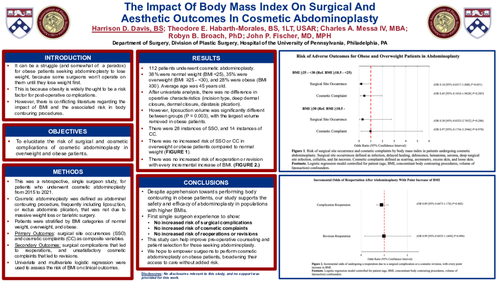
Results: 112 patients underwent cosmetic abdominoplasty. 38% were normal weight (BMI <25), 35% were overweight (BMI ≥25 - <30), and 28% were obese (BMI ≥30). Average age was 45 years old. After univariate analysis, there was no difference in operative characteristics (incision type, deep dermal closure, dermal closure, diastasis plication). However, liposuction volume was significantly different between groups (P = 0.003), with the largest volume removed in obese patients. There were 28 instances of SSO, and 14 instances of CC. There was no increased risk of SSO or CC in overweight or obese patients compared to normal weight (FIGURE 1). There was no increased risk of reoperation or revision with every incremental increase of BMI. (FIGURE 2.)
Conclusions: Despite apprehension towards performing body contouring in obese patients, our study supports the safety and efficacy of abdominoplasty in populations with higher BMIs.
First single surgeon experience to show: