212 posters, 10 topics, 5 sessions, 754 authors, 237 institutions
ePostersLive by SciGen Technologies S.A. All rights reserved.
The AAPS 101st Annual Meeting
29 April – 2 May, 2023 | Chicago, IL

D45
Early Outcomes Of Muscle Flap Closures In Complex Spine Surgeries: A Propensity-matched Cohort Analysis
Part of Topic
Outcomes
Introduction
Early Outcomes Of Muscle Flap Closures In Complex Spine Surgeries: A Propensity-matched Cohort Analysis
Jung Ho Gong AB,1 Rahul Sastry MD,1 Daniel J. Koh BA,2 Luke Soliman MTS,1 Nikhil Sobti MD,1 Jared Fridley MD,1 Albert S. Woo MD1
1 Division of Plastic and Reconstructive Surgery, Warren Alpert Medical School, Brown University
2 Boston University Chobanian & Avedisian School of Medicine, Boston, Massachusetts
Plastic surgery closure with muscle flaps after complex spinal
reconstruction has become increasingly more common.
Existing evidence for this practice consists of small,
uncontrolled, single-center cohort studies. We aimed to
compare 30-day postoperative wound-related complication
rates between flap closure and traditional closure after
posterior thoracolumbar fusions (PTLFs) for non-infectious,
non-oncologic pathologies using a national database.
Methods
Conclusions
Results
100,799 PTLFs met our inclusion criteria. The use of flap closure with PTLF remained
low but more than doubled from 2012 to 2020 (0.38% vs. 0.97%; p=0.002). A higher
proportion of flap closures had higher ASA classifications and higher number of operated
spine levels (all p<0.001). 1,907 PTLFs (630 for flap closure; 1,257 for traditional closure)
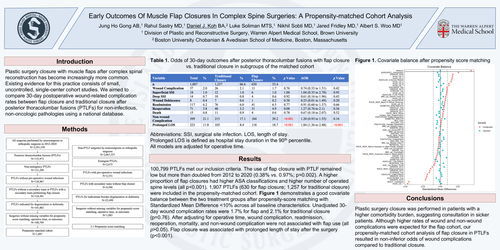
were included in the propensity-matched cohort. Figure 1 demonstrates a good covariate
balance between the two treatment groups after propensity-score matching with
Standardized Mean Difference <10% across all baseline characteristics. Unadjusted 30-
day wound complication rates were 1.7% for flap and 2.1% for traditional closure
(p=0.76). After adjusting for operative time, wound complication, readmission,
reoperation, mortality, and non-wound complication were not associated with flap use (all
p>0.05). Flap closure was associated with prolonged length of stay after the surgery
(p<0.001).
Figure 1. Covariate balance after propensity score matching
Plastic surgery closure was performed in patients with a
higher comorbidity burden, suggesting consultation in sicker
patients. Although higher rates of wound and non-wound
complications were expected for the flap cohort, our
propensity-matched cohort analysis of flap closure in PTLFs
resulted in non-inferior odds of wound complications
compared to traditional closure.
Table 1. Odds of 30-day outcomes after posterior thoracolumbar fusions with flap closure
vs. traditional closure in subgroups of the matched cohort
Abbreviations: SSI, surgical site infection. LOS, length of stay.
Prolonged LOS is defined as hospital stay duration in the 90th percentile.
All models are adjusted for operative time.