171 posters, 10 topics, 5 sessions, 690 authors, 211 institutions
ePostersLive by SciGen Technologies S.A. All rights reserved.
American Association of Plastic Surgeons Meeting 2022
April 9 - 12 | San Diego, California

P9
Practice Patterns, Part 2: An American Society Of Plastic Surgeons (asps) Member Survey, 2000 And 2020. How Much Has Browlifting Changed
Poster Presenter
Part of Topic
Aesthetic Face
-
Purpose
In 2001, Elkwood and Matarasso conducted an American Society of Plastic Surgeons (ASPS) member survey detailing browlift practice patterns.
-
Despite significant changes in approach over the past 20 years, no survey has been performed since.
-
We therefore repeated the original browlift survey, adding additional pertinent questions and queried currently practicing ASPS member surgeons.
Methods
-
A 34-question descriptive survey was electronically distributed to a random group of 2,360 ASPS members.
-
Techniques for correction of brow ptosis, forehead and glabella/corrugator lines, and ancillary techniques used at the time of forehead rejuvenation were assessed.
-
Additional queried topics included open approaches, nonsurgical approaches (e.g., fillers and neuromodulators), facial feminization surgery (FFS), concomitant procedures when performing browlift, and surgeons’ perceptions of change over time.
-
Results were then compared to the 2001 survey.
Results
-
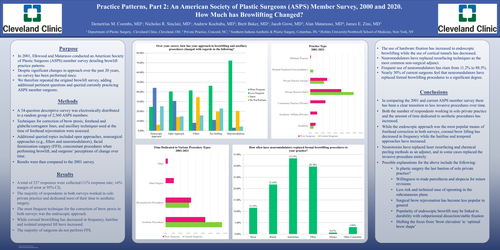
A total of 257 responses were collected (11% response rate; ±6% margin of error at 95% CI).
-
The majority of respondents in both surveys worked in solo private practice and dedicated most of their time to aesthetic surgery.
-
The most frequent technique for the correction of brow ptosis in both surveys was the endoscopic approach.
-
While coronal browlifting has decreased in frequency, hairline and isolated temporal lift have increased.
-
The majority of surgeons do not perform FFS.
The use of hardware fixation has increased in endoscopic browlifting while the use of cortical tunnels has decreased.
Neuromodulators have replaced resurfacing techniques as the most common non-surgical adjunct.
Frequent use of neuromodulators has risen from 11.2% to 88.5%.
Nearly 30% of current surgeons feel that neuromodulators have replaced formal browlifting procedures to a significant degree.
Conclusions
In comparing the 2001 and current ASPS member survey there has been a clear transition to less invasive procedures over time.
Both the number of respondents working in solo private practice and the amount of time dedicated to aesthetic procedures has increased.
While the endoscopic approach was the most popular means of forehead correction in both surveys, coronal brow lifting has decreased in frequency while the hairline and temporal approaches have increased.
Neurotoxins have replaced laser resurfacing and chemical peeling methods as an adjunct, and in some cases replaced the invasive procedure entirely.
Possible explanations for the above include the following:
Is plastic surgery the last bastion of solo private practice?
Willingness to trade paresthesia and alopecia for minor revisions
Less risk and technical ease of operating in the subcutaneous plane
Surgical brow rejuvenation has become less popular in general
Popularity of endoscopic browlift may be linked to durability with subperiosteal dissection/stable fixation
Shifting the focus from ‘brow elevation’ to ‘optimal brow shape’
-
-