Loading...

171 posters, 10 topics, 5 sessions, 690 authors, 211 institutions

ePostersLive by SciGen Technologies S.A. All rights reserved.

American Association of Plastic Surgeons Meeting 2022

April 9 - 12 | San Diego, California

American Association of Plastic Surgeons Meeting 2022 banner

PC15

A Ten-year Review Of Dermal Filler Adverse Events Associated With Vaccination
Part of Topic

Aesthetic Face

A Ten-Year Review of Dermal Filler Adverse Events and Vaccination

Alexander H. Sun, MD, MHS1, Michele Manahan, MD, MBA1

1Department of Plastic and Reconstructive Surgery, Johns Hopkins Hospital, Baltimore, MD


Following the authorization of two mRNA COVID-19 vaccinations in December 2020, there was increased media attention surrounding reactions to vaccination associated with dermal filler use. Dermal filler adverse events are reported as medical device reports (MDRs) to the United States Food and Drug Administration (FDA). This project seeks to characterize reporting for dermal filler adverse events associated with vaccination over a 10-year period.

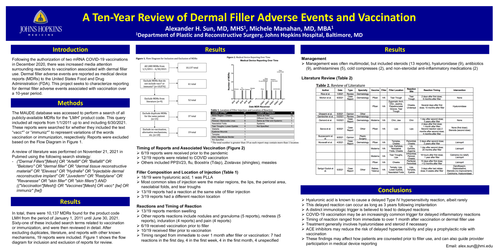
The MAUDE database was accessed to perform a search of all publicly-available MDRs for the “LMH” product code. This query included all reports from 1/1/2011 up to and including 6/30/2021. These reports were searched for whether they included the text “vacc*” or “immuniz*” to represent variations of the words vaccination or immunization, respectively. Reports were excluded based on the Flow Diagram in Figure 1. 


A review of literature was performed on November 21, 2021 in Pubmed using the following search strategy:

-("Dermal Fillers"[Mesh] OR "Artefill" OR "Bellafill" OR "Belotero" OR "dermal filler" OR "dermal tissue reconstructive material" OR "Elevess" OR "Hydrelle" OR "injectable dermal reconstructive implant" OR "Juvederm" OR "Restylane” OR "Revanesse" OR "skin filler" OR "skin fillers") AND (("Vaccination"[Mesh]) OR "Vaccines"[Mesh] OR vacc* [tw] OR immuniz* [tw])


In total, there were 10,137 MDRs found for the product code LMH from the period of January 1, 2011 until June 30, 2021. Sixty-one of these included search terms related to vaccination or immunization, and were then reviewed in detail. After excluding duplicates, literature, and reports with other known mechanisms, 19 reports were included. Figure 1 shows the flow diagram for inclusion and exclusion of reports for review.


Timing of Reports and Associated Vaccination (Figure 2)

Ø6/19 reports were received prior to the pandemic
Ø12/19 reports were related to COVID vaccination
ØOthers included PPSV23, flu, Boostrix (Tdap), Zostavax (shingles), measles
-

Filler Composition and Location of Injection (Table 1)

Ø18/19 were hyaluronic acid, 1 was PLLA
ØMost common sites of injection were the malar regions, the lips, the perioral area, nasolabial folds, and tear troughs
Ø13/19 reports had a reaction at the same site of filler injection
Ø3/19 reports had a different reaction location
Ø

Reactions and Timing of Reaction

Ø13/19 reports mention swelling
ØOther reports reactions include nodules and granuloma (5 reports), redness (5 reports), induration (4 reports) and pain (4 reports)
Ø6/19 received vaccination prior to filler
Ø10/19 received filler prior to vaccination
ØTiming ranged from immediate to over 1 month after filler or vaccination: 7 had reactions in the first day, 4 in the first week, 4 in the first month, 4 unspecified
 

Management

ØManagement was often multimodal, but included steroids (13 reports), hyaluronidase (9), antibiotics (9), antihistamines (5), cold compresses (2), and non-steroidal anti-inflammatory medications (2)
Ø

Literature Review (Table 2)

Ø
-


ØHyaluronic acid is known to cause a delayed Type IV hypersensitivity reaction, albeit rarely
ØThis delayed reaction can occur as long as 3 years following implantation
ØA distinct immunologic trigger is believed to lead to delayed reactions
ØCOVID-19 vaccination may be an increasingly common trigger for delayed inflammatory reactions
ØTiming of reaction ranged from immediate to over 1 month after vaccination or dermal filler use
ØTreatment generally involves hyaluronidase and steroid if necessary
ØACE inhibitors may reduce the risk of delayed hypersensitivity and play a prophylactic role with vaccination
ØThese findings may affect how patients are counseled prior to filler use, and can also guide provider participation in medical device reporting
Ø


American Association of Plastic Surgeons Meeting 2022 » banner
Copyright © 2015-2026, ePostersLive® SciGen is a registered trademark of SciGen Technologies S.A. Patent pending.

This website and third-party tools we use rely on cookies for the best user experience. By selecting "I agree", you agree to cookie usage as described in our Privacy Policy.