171 posters, 10 topics, 5 sessions, 690 authors, 211 institutions
ePostersLive by SciGen Technologies S.A. All rights reserved.
American Association of Plastic Surgeons Meeting 2022
April 9 - 12 | San Diego, California

PC24
Comparison Of Bilateral Gluteal Artery Perforator Flaps To Vertical Rectus Abdominis Musculocutaneous Flaps In Reconstruction Of Perineal Wounds
Poster Presenter
Authors
Katherine Benedict, Somjade Songcharoen, Kristen Stephens, Anna Winter, Shelley Edwards, Christopher Campbell, Peter Arnold
Affiliations
University of Mississippi Medical Center Division of Plastic and Reconstructive Surgery, University of Virginia Department of Plastic and Reconstructive Surgery
Part of Topic
General Reconstruction
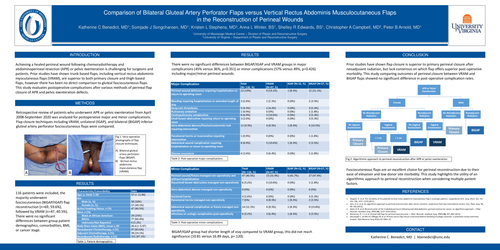
Achieving a healed perineal wound following chemoradiotherapy and abdominoperineal resection (APR) or pelvic exenteration is challenging for surgeons and patients. Prior studies have shown trunk-based flaps; including vertical rectus abdominis myocutaneous flaps (VRAM), are superior to both primary closure and thigh-based flaps, however there has been no direct comparison to gluteal fasciocutaneous flaps. This study evaluates postoperative complications after various methods of perineal flap closure of APR and pelvic exenteration defects.
Retrospective review of patients who underwent APR or pelvic exenteration from April 2008-September 2020 was analyzed for postoperative major and minor complications. Flap closure techniques including VRAM, unilateral (IGAP), and bilateral (BIGAP) inferior gluteal artery perforator fasciocutaneous flaps were compared.
116 patients were included, the majority underwent fasciocutaneous (BIGAP/IGAP) flap reconstruction (n=69, 59.6%), followed by VRAM (n=47, 40.5%). There were no significant differences between group patient demographics, comorbidities, BMI, or cancer stage. There were no significant differences between BIGAP/IGAP and VRAM groups in major complications (45% versus 36%, p=0.351) or minor complications (57% versus 49%, p=0.426) including major/minor perineal wounds. BIGAP/IGAP group had shorter length of stay compared to VRAM group, this did not reach significance (10.81 versus 16.89 days, p=.120).
Prior studies have shown flap closure is superior to primary perineal closure after neoadjuvant radiation, but lack consensus on which flap offers superior post-operative morbidity.This study comparing outcomes of perineal closure between VRAM and BIGAP flaps showed no significant difference in post-operative complication rates. Fasciocutaneous flaps are an excellent choice for perineal reconstruction due to their ease of elevation and low donor site morbidity. This study highlights the utility of an algorithmic approach to perineal reconstruction when considering multiple patient factors.