171 posters, 10 topics, 5 sessions, 690 authors, 211 institutions
ePostersLive by SciGen Technologies S.A. All rights reserved.
American Association of Plastic Surgeons Meeting 2022
April 9 - 12 | San Diego, California

P114
Reconstruction Of The Hemilarynx After Hemilaryngectomy For Unilateral Advanced Larynx Tumors. The Learning Curve After 100 Cases Of Hemilaryngeal Reconstruction By A Prefabricated Trachea.
Poster Presenter
Part of Topic
General Reconstruction
Introduction
Even in unilateral larynx cancers, the conventional treatment consists of a total laryngectomy, which results in a permanent tracheostome and loss of natural speech.
Larynx preservation surgery aims to restore the resected half.
Our tracheal autotransplantation technique for hemilaryngeal reconstruction is preserved for selected cases of unilateral T2 or T3 glottic squamous cell carcinoma’s and advanced chondrosarcoma’s of the cricoid cartilage.
When compared to other larynx preservation strategies, tracheal autotransplantation provides favorable oncologic and functional outcomes. However, the occurrence of aspiration pneumonia due to recurrent aspiration, impaired voice quality and a lasting tracheostome may trouble this technique.
In the original protocol (n= 40), the prefabrication of trachea occurred prior to the tumor resection. After 3 weeks of prefabrication, tumor resection took place and the prefabricated trachea segment was used to close the defect.
In the current protocol (since 2004, n= 45), the tumor is resected in first stage in combination with the prefabrication of trachea. In a 2nd stage after 4 months, the prefabricated revascularized trachea segment is used to restore the laryngeal defect.
This oncologically safer sequence required a new flap design.
In this study we retrospectively analyzed the outcome parameters of our original and modified reconstructive protocols, totaling 85 cases.
Methods
An extended hemilaryngectomy defect involving up to half of the cricoid cartilage can be reconstructed with the top 4 cm of the cervical trachea. We developed a two-stage technique to combine hemilaryngectomy with a prefabrication of the upper 4 cm of the trachea by wrapping the segment with the fascial part of a free fasciocutaneous radial forearm flap. In the second stage of the procedure the laryngeal reconstruction is completed by means of tracheal autotransplantation. We performed a retrospective analysis of 85 cases(n=85) of tracheal autotransplantation. Conversion to total laryngectomy, the presence of a tracheostoma, adequate voice quality and locoregional recurrence were the outcomes included in our research. We also compared the outcomes after implementing a second treatment protocol. A statistical analysis was performed to check statistical significance of the improved outcomes after implementation of the second treatment protocol.
Results
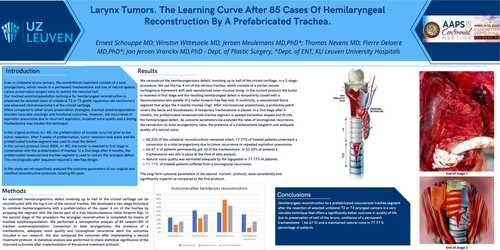
We reconstruct the hemilaryngectomy defect, involving up to half of the cricoid cartilage, in a 2-stage procedure. We use the top 4 cm of the cervical trachea, which consists of a similar convex cartilaginous framework with well vascularized inner mucosal lining. In the current protocol the tumor is resected in first stage and the resulting hemilaryngeal defect is temporarily closed with a fasciocutaneous skin paddle of a radial forearm free flap and, in continuity, a vascularized fascia segment that wraps the 4 nearby trachea rings. After microvascular anastomosis, a protective patch covers the fascia and bloodvessels. A temporary tracheostome is placed. In a 2nd stage after 4 months, the prefabricated revascularized trachea segment is opened horseshoe shaped and fit into the hemilaryngeal defect. As outcome parameters we analyzed the rates of locoregional recurrence, the conversion-to-total laryngectomy rates, the presence of a tracheostome longterm and adequate quality of a natural voice.
- 82.23% of the unilateral reconstructions remained intact; 17.77% of treated patients underwent a conversion to a total laryngectomy due to tumor recurrence or repeated aspiration pneumonia.
- 66.67 % of patients permanently got rid of the tracheostome. In 33.33% of patients a tracheostome was still in place at the time of data analysis.
- Natural voice quality was estimated adequate by the logopedist in 77.77% of patients.
- 11.11%of treated patients suffered from a locoregional recurrence.
The long-term outcome parameters of the second -current- protocol, were consistently and significantly superior as compared to the first protocol.
Conclusions
Hemilaryngeal reconstruction by a prefabricated vascularized trachea segment after the resection of selected unilateral T2 or T3 laryngeal cancers is a very valuable technique that offers a significantly better outcome in quality of life due to preservation of half of the larynx, omittance of a permanent tracheostome( 66.67 %) and a maintained natural voice in 77.77 %percentage of patients.