171 posters, 10 topics, 5 sessions, 690 authors, 211 institutions
ePostersLive by SciGen Technologies S.A. All rights reserved.
American Association of Plastic Surgeons Meeting 2022
April 9 - 12 | San Diego, California

P124
Comparison Of Regenerative Limb Salvage To Flap-based Reconstruction Of Complex Extremity Wounds: A Randomized Control Trial
Poster Presenter
Authors
Affiliations
Part of Topic
General Reconstruction
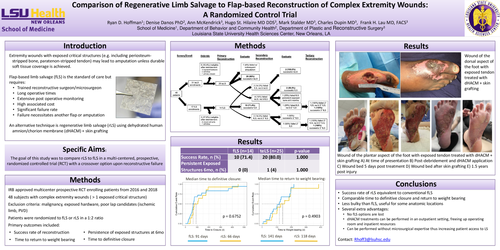
Comparison of Regenerative Limb Salvage to Flap-based Reconstruction of Complex Extremity Wounds:
A Randomized Control Trial
Ryan D. Hoffman1; Denise Danos PhD2, Ann McKendrick3, Hugo St. Hilaire MD DDS3, Mark Stalder MD3, Charles Dupin MD3, Frank H. Lau MD, FACS3
School of Medicine1, Department of Behavior and Community Health2, Department of Plastic and Reconstructive Surgery3
Louisiana State University Health Sciences Center, New Orleans, LA
Introduction
Extremity wounds with exposed critical structures (e.g. including periosteum-stripped bone, paratenon-stripped tendon) may lead to amputation unless durable soft tissue coverage is achieved.
Flap-based limb salvage (fLS) is the standard of care but
requires:
An alternative technique is regenerative limb salvage (rLS) using dehydrated human amnion/chorion membrane (dHACM) + skin grafting
Specific Aim
The goal of this study was to compare rLS to fLS in a multi-centered, prospective, randomized controlled trial (RCT) with a crossover option upon reconstructive failure
Methods
IRB approved multicenter prospective RCT enrolling patients from 2016 and 2018
48 subjects with complex extremity wounds ( > 1 exposed critical structure)
Exclusion criteria: malignancy, exposed hardware, poor lap candidates (ischemic limb, PVD)
Patients were randomized to fLS or rLS in a 1:2 ratio
Primary outcomes included:
Median time to definitive closure:
fLS: 91 days rLS: 66 days p = 0.6752
Median time to return to weight bearing:
fLS: 141 days rLS: 118 days p = 0.4903
Contact: Rhoff3@lsuhsc.edu