171 posters, 10 topics, 5 sessions, 690 authors, 211 institutions
ePostersLive by SciGen Technologies S.A. All rights reserved.
American Association of Plastic Surgeons Meeting 2022
April 9 - 12 | San Diego, California

P121
The Use Of Flow-through Free Flaps for Head and Neck Reconstruction
Poster Presenter
Part of Topic
General Reconstruction
The Use of Flow-through Free Flaps for Head and Neck Reconstruction
Mark A. Maier, BS 1; Patrick A. Palines, MD 2; Richard F. Guidry, MD 2; Mark W. Stalder, MD 2
1 School of Medicine, Louisiana State University Health Sciences Center, New Orleans, LA
2 Division of Plastic and Reconstructive Surgery, Dept. of Surgery, Louisiana State University Health Sciences Center, New Orleans, LA
mmaie1@lsuhsc.edu; ppalin@lsuhsc.edu; rguid6@lsuhsc.edu; mstald@lsuhsc.edu
Introduction & Purpose
Reconstructive obstacles in composite head and neck defects are compounded in re-operated, irradiated, and vessel-depleted surgical fields.1
Strategic flow-through flap configurations mitigate recipient vessel inaccessibility and inset logistics by providing a built-in option for inflow to a second flap (Figure 1).2,3
Purpose: Configure head and neck flow-through free flaps to:
Use a lone native recipient vessel
Increase reach of inflow vessels and flap flexibility for composite reconstruction
Figure 1. Flow-through flap concept schematic.
OBJECTIVE: Describe our technique and outcomes of reconstructing complex head and neck deformities using soft tissue and bony free flaps in a flow-through configuration.
Methods
Retrospective Case Review: 38 head and neck free flap cases were reviewed from University Medical Center in New Orleans, LA from March 2019 to April 2021; 9 cases configured free flaps in a flow-through fashion.
Flow-through Flaps: soft tissue and osseus flaps are arranged in series connecting recipient vessels to the proximal flap and the proximal flap to the distal flap (Figures 2, 3).
Analysis: patient age/sex, history, tobacco, radiation, defect, recipient vessels, flow-through flap, number of perforators, second flap, complications, and follow-up were reviewed and described (Table 1).
Results & Case Images
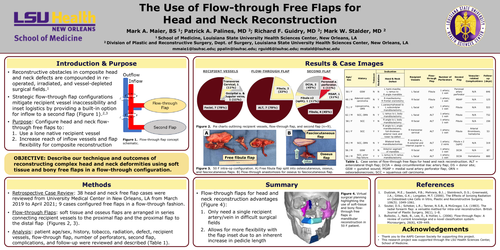
Figure 2. Pie charts outlining recipient vessels, flow-through flap, and second flap (n=9).
Figure 3. 50 F intra-op configuration. A) Free fibula flap split into osteocutaneous, osseus, and fasciocutaneous flaps. B) Flow-through anastomosis for osseus to fasciocutaneous flap.
Table 1. Case series of flow-through free flaps for head and neck reconstruction. ALT = anterolateral thigh flap; DCIA = deep circumferential iliac artery flap; DS = donor site; GSW = gunshot wound; MSAP = medial sural artery perforator flap; ORN = osteoradionecrosis; SCC = squamous cell carcinoma.
Summary
Flow-through flaps for head and neck reconstruction advantages (Figure 4):
Only need a single recipient artery/vein in difficult surgical fields
Allows for more flexibility with the flap inset due to an inherent increase in pedicle length
Figure 4. Virtual surgical planning highlighting the use of soft-tissue and bony flow-through free flaps in mandibular reconstruction in 50 F patient.
References
Dudziak, M.E.; Saadeh, P.B.; Mehrara, B.J..; Steinbrech, D.S.; Greenwald, J.A.; Gittes, G.K.; Longaker, M.T. (2000). The Effects of Ionizing Radiation on Osteoblast-Like Cells in Vitro, Plastic and Reconstructive Surgery, 106(5). 1049-1061
Soutar, D.S.; Scheker, L.R.; Tanner, N.S.B., & McGregor, I.A. (1983). The radial forearm flap: a versatile method for intra-oral reconstruction. British Journal of Plastic Surgery, 36(1), 1–8.
Bullocks, J., Naik, B., Lee, E., & Hollier, L. (2006). Flow-through flaps: A review of current knowledge and a novel classification system. Microsurgery, 26(6), 439–449.
Acknowledgements
Thank you to the AAPS Cannon Society for supporting this project.
This research project was supported through the LSU Health Sciences Center, School of Medicine.