171 posters, 10 topics, 5 sessions, 690 authors, 211 institutions
ePostersLive by SciGen Technologies S.A. All rights reserved.
American Association of Plastic Surgeons Meeting 2022
April 9 - 12 | San Diego, California

P98
Home Sweet Home: The Integrated Plastic Surgery Residency Match During The COVID-19 Pandemic
Poster Presenter
Part of Topic
Education/Practice Management/Other
Home Sweet Home – The Integrated Plastic Surgery Residency Match During The COVID-19 Pandemic
Introduction:
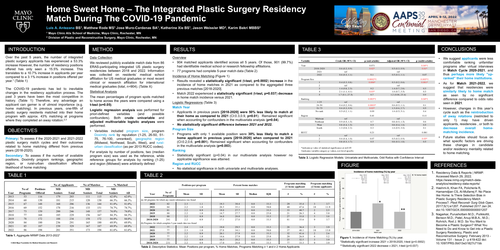
Over the past 5 years, the number of integrated plastic surgery applicants has experienced a 53.3% increase However, the number of residency positions offered has only seen a 15.5% increase. This translates to a 10.7% increase in applicants per year compared to a 3.1% increase in positions offered per year.1 (Table 1)
The COVID-19 pandemic has led to inevitable changes in the residency application process. The past 3 years have been the most competitive in history. (Table 1) Therefore, any advantage an applicant can garner is of utmost importance (e.g. home matching). In previous years, one-fifth of plastic surgery residents matched into their home program with approx. 43% matching at programs where they completed an away rotation.2,3
Objectives:
Primary: To assess if the 2020-2021 and 2021-2022 plastic surgery match cycles and their outcomes related to home matching differed from previous years (2018-2020).
Secondary: To assess if the number of available positions, Doximity program rankings, geographic region, or rural-urban classification affected likelihood of home matching
Methods:
Data Collection
We reviewed publicly available match data from 86 ERAS-participating integrated US plastic surgery residencies between 2018 and 2022. Information was collected on residents’ medical school affiliation for US medical graduates or most recent clinical or research affiliation for international medical graduates (total, n=904). (Table X)
Statistical Analysis
The mean percentages of program spots matched to home across the years were compared using a t-test (α=0.05).
Logistic regression analysis was performed for priori-defined variables (and possible confounders). Both crude univariable and adjusted multivariable logistic analyses were performed.
For analysis by number of positions, two (median program size) was used as the reference, while reference groups for analysis by ranking (1-25) and region (Midwest) were arbitrarily defined
Results:
Overview
Incidence of Home Matching (Figure 1)
Logistic Regressions (Table 3)
Match Year
Program Size
Ranking
Region and RUCC