171 posters, 10 topics, 5 sessions, 690 authors, 211 institutions
ePostersLive by SciGen Technologies S.A. All rights reserved.
American Association of Plastic Surgeons Meeting 2022
April 9 - 12 | San Diego, California

P85
Artificially Intelligent Facial Feature Quantification After Facial Filler Injection
Poster Presenter
Authors
Ankoor Talwar, Abhishek Desai, Phoebe McAuliffe, Robyn Broach, Joseph Serletti, Ivona Percec
Affiliations
Part of Topic
Education/Practice Management/Other
Artificially Intelligent Facial Feature Quantification after Facial Filler Injection
Ankoor A. Talwar, MBA1; Abhishek A. Desai, MD1; Phoebe B. McAuliffe, BA1; Robyn B. Broach, PhD1; Joseph M. Serletti, MD1; Ivona Percec, MD PhD1
1Division of Plastic Surgery, University of Pennsylvania
Applications of Artificial Intelligence (AI) are becoming increasingly ubiquitous in surgery. Commercially available AI facial analysis systems can be used to assess aesthetic treatments such as facelift or facial feminization surgery. Additionally, these algorithms may be useful in the assessment of facial dermal filler injections. The purposes of this study are to determine the degree of change in a patient’s AI-estimated age over the 90 days following cosmetic filler injection, and to correlate this change with patient-reported perception of aging.
Objective: To determine if facial filler injection affects AI-perceived age
Hypothesis: Facial filler injection will decrease AI-perceived age temporarily, but this effect will wane over time as the filler is resorbed
Women aged 40-65 were recruited and injected with Restylane® dermal fillers in a standardized fashion. Patients were photographed using the Vectra® M3 3D Imaging device and administered the FACE-QTM quality-of-life questionnaire at five time-points: before injection, immediately post-intervention, 2-weeks, 4-weeks, and 12-weeks post-injection. AI age estimation was performed using two commercially available AI algorithms: Amazon Rekognition API and Microsoft Azure Face API.
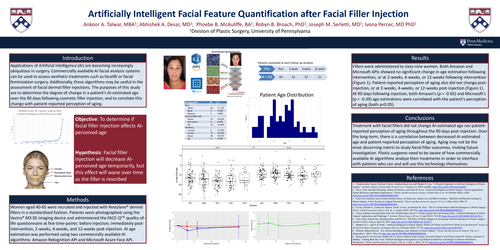
Fillers were administered to sixty-nine women. Both Amazon and Microsoft APIs showed no significant change in age estimation following intervention, or at 2-weeks, 4-weeks, or 12-weeks following intervention (Figure 1). Patient-reported perception of aging also did not change post-injection, or at 2-weeks, 4-weeks, or 12-weeks post-injection (Figure 1). At 90 days following injection, both Amazon’s (p = -0.65) and Microsoft’s (p = -0.39) age estimations were correlated with the patient’s perception of aging (both p<0.05).
Treatment with facial fillers did not change AI-estimated age nor patient-reported perception of aging throughout the 90 days post-injection. Over the long-term, there is a correlation between decreased AI-estimated age and patient-reported perception of aging. Aging may not be the most discerning metric to study facial filler outcomes, inviting future investigation. Plastic surgeons need to be aware of how commercially available AI algorithms analyze their treatments in order to interface with patients who can and will use this technology themselves.