171 posters, 10 topics, 5 sessions, 690 authors, 211 institutions
ePostersLive by SciGen Technologies S.A. All rights reserved.
American Association of Plastic Surgeons Meeting 2022
April 9 - 12 | San Diego, California

P97
Do Plastic Surgery Residents Get Sued? An Analysis Of Malpractice Lawsuits
Poster Presenter
Authors
Affiliations
Part of Topic
Education/Practice Management/Other
Do Plastic Surgery Residents Get Sued? An Analysis of Malpractice Lawsuits
Alexander R. Gibstein, BA; Sinan K. Jabori, MD; Arjun Watane, MD; Benjamin Slavin, MD; Rawan Elabd, MD; Iakov V Efimenko, BS; Devinder Singh, MD
Introduction
• Plastic and reconstructive surgery carries a high risk for malpractice litigation
• Trainees may be implicated in malpractice lawsuits
• Our study has evaluated the percentage of malpractice cases among plastic surgery residents and quantified the financial impact on their career
Objectives
• To analyze the events that precipitated litigation to better understand how to:
• Prevent future occurrence
• Improve malpractice education in residency programs
• Decrease this burden on future plastic surgeons
• Improve patient satisfaction and outcomes
Methods
• Jury verdicts and settlements from appellate state and federal cases between February 1988 and 2020 were queried from the LexisNexis legal database
• Data collected from these cases included:
• Plaintiff and patient demographics
• Case characteristics
• Allegations
• Outcomes
• Cases were manually reviewed by 2 independent authors
Results:
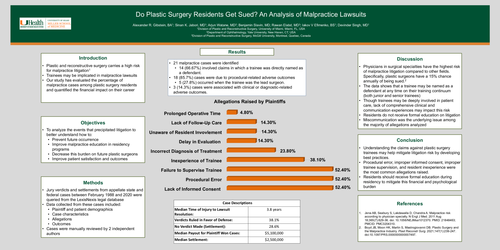
• 21 malpractice cases were identified
• 14 (66.67%) involved claims in which a trainee was directlynamed as a defendant.
• 18 (85.7%) cases were due to procedural-related adverse
outcomes
• 5 (27.8%) occurred when the trainee was the lead surgeon.
• 3 (14.3%) cases were associated with clinical or diagnosticrelated adverse outcomes.
Discussion:
• Physicians in surgical specialties have the highest risk of malpractice litigation compared to other fields. Specifically, plastic surgeons have a 15% chance annually of being sued.
• The data shows that a trainee may be named as a defendant at any time on their training continuum (both junior and senior trainees)
• Though trainees may be deeply involved in patient care, lack of comprehensive clinical and communication experiences may impact this risk
• Residents do not receive formal education on litigation
• Miscommunication was the underlying issue among the majority of allegations analyzed
Conclusion:
• Understanding the claims against plastic surgery trainees may help mitigate litigation risk by developing best practices.
• Procedural error, improper informed consent, improper trainee supervision, and resident inexperience were the most common allegations raised.
• Residents should receive formal education during residency to mitigate this financial and psychological burden