171 posters, 10 topics, 5 sessions, 690 authors, 211 institutions
ePostersLive by SciGen Technologies S.A. All rights reserved.
American Association of Plastic Surgeons Meeting 2022
April 9 - 12 | San Diego, California

P96
Expanding Burn Expertise Through Telemedicine For The Frontliners During The Covid-19 Pandemic
Poster Presenter
Part of Topic
Education/Practice Management/Other
EXPANDING BURN EXPERTISE THROUGH TELEMEDICINE FOR THE FRONTLINERSDURING THE COVID-19 PANDEMIC
Myra Alexandra Pahilan-Firaza, MD, DPBS, MHA-MPA; Maria RedencionBukid-Abella, MD, FPCS, FPAPRAS
Jose R. Reyes Memorial Medical Center, Section of Plastic, Reconstructive, and Aesthetic Surgery, Manila, Philippines
Philippine Association of Plastic, Reconstructive, and Aesthetic Surgeons
INTRODUCTION
Inexperience of frontlinersand referring physicians from non-specialty centers in burn wound assessment results to the incorrect triage of patients, thereby aggravating the current hospital situations and causing unnecessary exposures. Jose R. Reyes Memorial Medical Center (JRRMMC) is one of the six hospitals in the Philippines with a specialized Burn Unit catering to over 110 million Filipinos. An early and accurate diagnosis is critical in providing optimal burn care. These challenges can be amenable to telehealthsolutions by establishing an online burn referral system using smartphones.
OBJECTIVES
This is a cross-sectional study that determines the accuracy and timeliness in diagnosing and classifying burn patients assessed by a frontliner Non-BurnSpecialist in-person (NBSP), a Burn Specialist online (BSO), and a Burn Specialist in-person (BSP).
METHODOLOGY
All burn patients seen at the JRRMMC – Emergency Room for a 3-month period were initially examined by a NBSP with signed consents for participation. The estimation of the % TBSA was based on the Lund and Browder chart. Photographs were taken in a standardized manner using a smartphone (with a minimum camera resolution of 8 MP), and referred to a BSO via a smartphone messaging application.These patients were also assessed independently by the BSP. The % total body surface area (TBSA), burn depth classification, and the time the patients were seen by the NBSP, the time the online referrals were sent to the BSO through the messaging application, the time the BSO sent the diagnoses, and the time of assessment by the BSP, were recorded.
RESULTS AND DISCUSSION
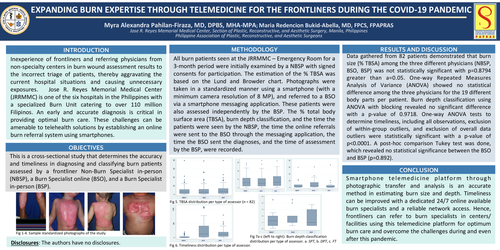
Data gathered from 82 patients demonstrated thatburn size (% TBSA) among the three different physicians (NBSP, BSO, BSP) was not statistically significant with p=0.8794 greater than a=0.05. One-way Repeated Measures Analysis of Variance (ANOVA) showed no statistical difference among the three physicians for the 19 different body parts per patient. Burn depth classification using ANOVA with blocking revealed no significant difference with a p-value of 0.9718. One-way ANOVA tests to determine timeliness, including all observations, exclusion of within-group outliers, and exclusion of overall data outliers were statistically significant with a p-value of p<0.0001. A post-hoc comparison Tukey test was done, which revealed no statistical significance between the BSO and BSP (p=0.892).
CONCLUSION
Smartphone telemedicine platform through photographic transfer and analysis is an accurate method in estimating burn size and depth. Timeliness can be improved with a dedicated 24/7 online available burn specialists and a reliable network access. Hence, frontlinerscan refer to burn specialists in centers/facilities using this telemedicine platformfor optimum burn care and overcome the challenges during and even after this pandemic.