171 posters, 10 topics, 5 sessions, 690 authors, 211 institutions
ePostersLive by SciGen Technologies S.A. All rights reserved.
American Association of Plastic Surgeons Meeting 2022
April 9 - 12 | San Diego, California

PC11
Use of Hedgehog Inhibitors in the Treatment of Gorlin Syndrome
Poster Presenter
Part of Topic
General Reconstruction
USE OF HEDGEHOG INHIBITORS IN THE TREATMENT OF GORLIN SYNDROME
Background:
Gorlin Syndrome, or Nevoid Basal Cell Carcinoma Syndrome (NBCCS), is a rare genetic disorder characterized by multiple basal cell carcinomas (BCC). Although serial excisions have traditionally been used to decrease tumor burden, recent advancements in our understanding of Sonic Hedgehog (SHH) pathways and their mutations in NBCCS have shed light on alternative targeted treatments. The purpose of this study was to explore the impact of SHH pathway inhibitors in reducing the incidence of new BCCs and need for debulkingsurgeries.
Methods:
A retrospective chart review of patients with NBCCS was performed at a single academic institution over 20 years (1999-2019). Eligibility criteria included: age greater than 18 years, diagnostic criteria of NBCCS met, treatment with a SHH pathway inhibitor, and at least four years of follow up from initial presentation. Each patient served as their own control to calculate new BCC developed per year and BCC surgeries conducted before and after initiation of treatment with a SHH pathway inhibitor.
Results:
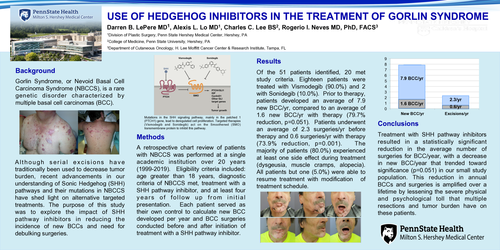
Of the 51 patients identified, 20 met study criteria. Eighteen patients were treated with Vismodegib (90.0%) and 2 with Sonidegib (10.0%). Prior to therapy, patients developed an average of 7.9 new BCC/yr, compared to an average of 1.6 new BCC/yr with therapy (79.7%reduction, p=0.051). Patients underwent an average of 2.3 surgeries/yrbefore therapy and 0.6 surgeries/yr with therapy (73.9% reduction, p=0.001). The majority of patients (80.0%) experienced at least one side effect during treatment (dysgeusia, muscle cramps, alopecia). All patients but one (5.0%) were able to resume treatment with modification of treatment schedule.
Conclusions:
Treatment with SHH pathway inhibitors resulted in a statistically significant reduction in the average number of surgeries for BCC/year, with a decrease in new BCC/year that trended toward significance (p=0.051) in our small study population. This reduction in annual BCCs and surgeries is amplified over a lifetime by lessening the severe physical and psychological toll that multiple resections and tumor burden have on these patients.