171 posters, 10 topics, 5 sessions, 690 authors, 211 institutions
ePostersLive by SciGen Technologies S.A. All rights reserved.
American Association of Plastic Surgeons Meeting 2022
April 9 - 12 | San Diego, California

PC9
When To Cut? Differences In Outcomes Between Early And Ultra-early Excision Of Burn Injuries With >=20%TBSA.
Poster Presenter
Authors
Tomer Lagziel, Arya Akhavan, Sophie Cemaj, Joshua Yoon, Eliana Duraes, Julie Caffrey, Charles Hultman
Affiliations
Johns Hopkins University School of Medicine, Department of Plastic and Reconstructive Surgery, University of Nebraska Medical Center, UNMC College of Medicine, Cleveland Clinic, Department of Plastic and Reconstructive Surgery
Part of Topic
General Reconstruction
Title:
When to cut? Differences in outcomes between immediate, ultra-early, and early excision of burn wounds >20%TBSA
Authors:
Tomer Lagziel, BS12; Arya A. Akhavan, MD1; Sophie Cemaj, MD2; Joshua Yoon, MD3; Eliana F.R. Duraes, MD, PhD4; Julie Caffrey, DO, MS1; C. Scott Hultman, MD, MBA1
Affiliations:
1 - Department of Plastic and Reconstructive Surgery, Johns Hopkins University School of Medicine, Baltimore, MD, USA;
2 - Sackler Faculty of Medicine, Tel-Aviv University, Tel-Aviv, Israel;
3 - University of Nebraska Medical Center, UNMC College of Medicine, Omaha, Nebraska, USA;
4 - Department of Plastic and Reconstructive Surgery, Cleveland Clinic, Cleveland, OH;
Background:
Primary surgical intervention of large burns mandates surgical excision followed by skin grafting. Delayed excision post-injury is thought to allow for resuscitationand correction of physiologic derangements.
Precise optimal timing for burn wound excision has not been determined and remains controversial. Our previous research involving animal models and a systematic review suggests a possible clinical superiorityassociated with immediate/ultra-early excision.
Purpose:
To assess whether there is a difference in outcomes if initial excision is performed immediately(<24 hours), ultra-early (24-72 hours), or early (3-7 days) in adults with burns-related injuries of >20%TBSA.
Materials and Methods:
Retrospective review of 1035 adults admitted from 2016-2021.
Stratified our study groups based on their time to initial excision: Immediate (<24 hours), Ultra-Early (24-72 hours), and Early (3-7 days).
We assessed blood-loss during initial surgery, transfusion requirements, pain-levels, daily analgesic requirements, hospital-acquired complications, readmission rates, hospital length-of-stay (LOS), and mortality.
Results:
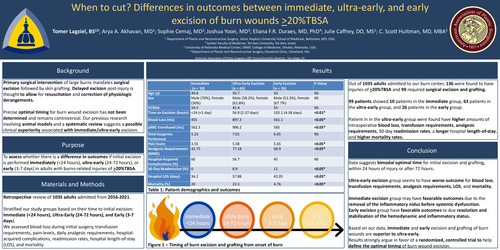
Out of 1035 adults admitted to our burn center, 136 were found to have injuries of >20%TBSA and 99required surgical excision and grafting.
99 patients showed 10 patients in the immediate group, 63 patients in the ultra-early group, and 26 patients in the early group.
Patient in in the ultra-early group were found have higher amounts of intraoperative blood loss, transfusion requirements,analgesic requirements, 30-day readmission rates, a longer hospitallength-of-stay, and highermortality rates.
Conclusion:
Data suggests bimodal optimal timefor initial excision and grafting, within 24 hours of injury or after 72 hours.
Ultra-early excision group seems to have worse outcome for blood loss, transfusion requirements,analgesic requirements, LOS, andmortality.
Immediate excision group may havefavorable outcomes due to the removal of the inflammatory nidus before systemic dysfunction.
Early excision group have favorable outcomes to due resolution and stabilization of the hemodynamic and inflammatory status.
Based on our data, immediate and early excision and grafting of burn wounds are superior to ultra-early.
Results strongly argue in favor of a randomized, controlled trial to help define the optimal timing of burn wound excision.