4,068 posters, 219 videos, 101 topics, 69 sessions, 14,365 authors, 6,128 institutions
ePostersLive by SciGen Technologies S.A. All rights reserved.
Alzheimer's Association International Conference 2026
July 12-15, 2026 | London, United Kingdom, and Online

10089
Multidomain Cognitive Performance In Covid-19 And Illness Controls Compared To Healthy Controls
Poster Presenter
Authors
Rebecca Bernal, Joy Zeynoun, Jonika Tannous, Monica G. Goss, Sachi Patel, Vibhuti N. Patel, Karl Li, Valentina R. Garbarino, Elsa Ruiz, Rejani R. Nair, Mohamad Habes, Tanweer Rashid, Francis B. Kolo, Heather M. Snyder, Gabriel A. De Erausquin, Mary Ganguli, Beth E. Snitz, Timothy D. Girard, Heidi I.L. Jacobs, Akram A. Hosseini, Tamer S. Ibrahim, Farhaan S. Vahidy, Claudia L. Satizabal, Jayandra Jung Himali, Sudha Seshadri
Affiliations
Massachusetts General Hospital, Boston, MA, USA, University of Pittsburgh, Pittsburgh, PA, USA, The Glenn Biggs Institute for Alzheimer’s & Neurodegenerative Diseases, The University of Texas Health Science Center at San Antonio, Department of Neurosurgery, Houston Methodist Research Institute, Houston, Texas, USA, Houston Methodist Research Institute, Houston, TX, US, Medical & Scientific Relations Division, Alzheimer's Association, Chicago, Illinois, United States, 6School of Medicine, University of Nottingham, Nottingham, Nottinghamshire, United Kingdom
Part of Topic
Video
Multidomain Cognitive Performance in COVID-19 and Illness Controls Compared to Healthy Controls
Rebecca Bernal1, Joy Zeynoun1,11, Jonika Tannous2, Monica G. Goss1,11, Sachi Patel1,11, Vibhuti N. Patel1,11, Karl Li1, Valentina R. Garbarino1, Elsa Ruiz2, Rejani R. Nair9, Mohamad Habes1, Tanweer Rashid1, Francis B. Kolo1, Heather M. Snyder3, Gabriel A. De Erausquin1,
Mary Ganguli4, Beth E. Snitz4, Timothy D. Girard4, Heidi I.L. Jacobs5, Akram A. Hosseini6,7,8, Tamer S. Ibrahim4, Farhaan S. Vahidy9,10, Claudia L. Satizabal1,11,12,13, Jayandra Jung Himali1,12,13,14,15, Sudha Seshadri1,12,14,16
On behalf of the 7T NeuroCOVID Consortium.
1The Glenn Biggs Institute for Alzheimer’s & Neurodegenerative Diseases, The University of Texas Health Science Center at San Antonio, 2Department of Neurosurgery, Houston Methodist Research Institute, Houston, Texas, USA, 3Medical & Scientific Relations Division, Alzheimer's Association, Chicago, Illinois, United States, 4University of Pittsburgh, Pittsburgh, PA, USA, 5Massachusetts General Hospital, Boston, MA, USA, 6School of Medicine, University of Nottingham, Nottingham, Nottinghamshire, United Kingdom, 7Academic Neurology, Nottingham University Hospitals NHS Trust, Queen's Medical Centre, Nottingham, Nottinghamshire, United Kingdom, 8Sir Peter Mansfield Imaging Centre, University of Nottingham, Nottingham, Nottinghamshire, United Kingdom, 9Houston Methodist Research Institute, Houston, TX, US, 10TIRR Memorial Hermann, Houston, TX, USA, 11South Texas Alzheimer's Disease Center, Glenn Biggs Institute for Alzheimer's and Neurodegenerative Diseases, UT Health San Antonio, San Antonio, Texas, USA, 12Department of Neurology, Boston University Chobanian & Avedisian School of Medicine, Boston, Massachusetts, USA, 13Department of Population Health Sciences, The University of Texas Health Science Center at San Antonio, San Antonio, Texas, USA, 14The Framingham Heart Study Framingham Massachusetts USA, 15Department of Biostatistics Boston University School of Public Health Boston Massachusetts USA, 16Department of Neurology UT Health San Antonio San Antonio Texas USA.
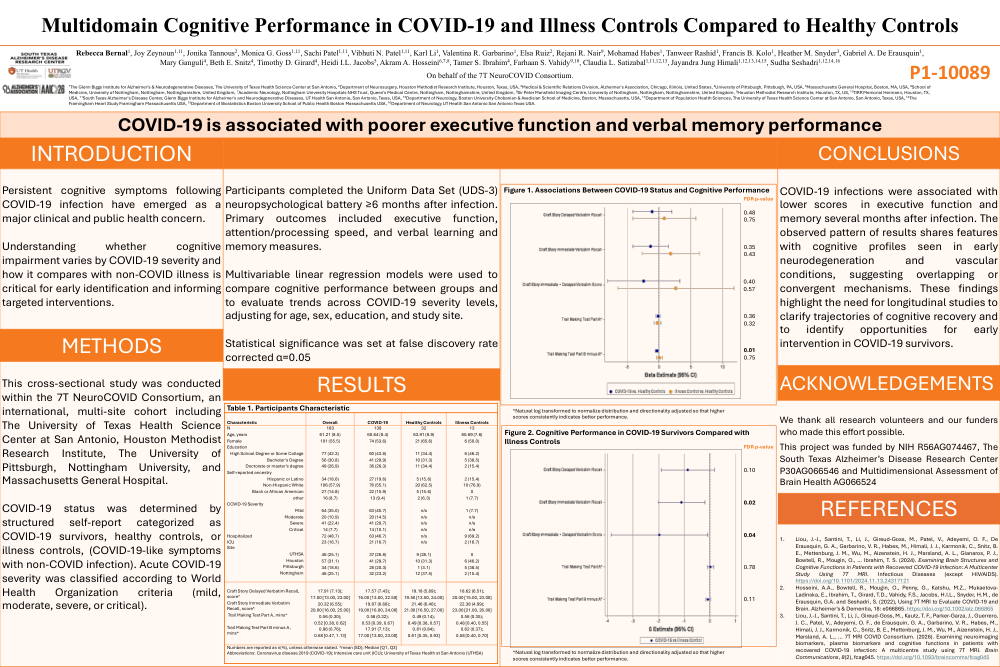
COVID-19 is associated with poorer executive function and verbal memory performance
INTRODUCTION:
Persistent cognitive symptoms following COVID-19 infection have emerged as a major clinical and public health concern.
Understanding whether cognitive impairment varies by COVID-19 severity and how it compares with non-COVID illness is critical for early identification and informing targeted interventions.
METHODS:
This cross-sectional study was conducted within the 7T NeuroCOVID Consortium, an international, multi-site cohort including The University of Texas Health Science Center at San Antonio, Houston Methodist Research Institute, The University of Pittsburgh, Nottingham University, and Massachusetts General Hospital.
COVID-19 status was determined by structured self-report categorized as COVID-19 survivors, healthy controls, or illness controls, (COVID-19-like symptoms with non-COVID infection). Acute COVID-19 severity was classified according to World Health Organization criteria (mild, moderate, severe, or critical).
Participants completed the Uniform Data Set (UDS-3) neuropsychological battery ≥6 months after infection. Primary outcomes included executive function, attention/processing speed, and verbal learning and memory measures.
Multivariable linear regression models were used to compare cognitive performance between groups and to evaluate trends across COVID-19 severity levels, adjusting for age, sex, education, and study site.
Statistical significance was set at false discovery rate corrected α=0.05
RESULTS:
|
Table 1. Participants Characteristic |
||||
|
Characteristic |
Overall |
COVID-19 |
Healthy Controls |
Illness Controls |
|
N Age, years Female Education High School Degree or Some College Bachelor’s Degree Doctorate or master’s degree Self-reported ancestry Hispanic or Latino Non-Hispanic White Black or African American other COVID-19 Severity Mild Moderate Severe Critical Hospitalized ICU UTHSA Houston Pittsburgh Nottingham
|
183 61.21 (8.5) 101 (55.5)
77 (42.3) 56 (30.8) 49 (26.9)
34 (18.6) 106 (57.9) 27 (14.8) 16 (8.7)
64 (35.0) 20 (10.9) 41 (22.4) 14 (7.7) 72 (48.7) 23 (16.7)
46 (25.1) 57 (31.1) 34 (18.6) 46 (25.1) |
138 60.64 (8.4) 74 (53.6)
60 (43.8) 41 (29.9) 36 (26.3)
27 (19.6) 76 (55.1) 22 (15.9) 13 (9.4)
63 (45.7) 20 (14.5) 41 (29.7) 14 (10.1) 63 (46.7) 21 (16.7)
37 (26.8) 41 (29.7) 28 (20.3) 32 (23.2) |
32 63.91 (8.9) 21 (65.6)
11 (34.4) 10 (31.3) 11 (34.4)
5 (15.6) 20 (62.5) 5 (15.6) 2 (6.3)
n/a n/a n/a n/a n/a n/a
9 (28.1) 10 (31.3) 1 (3.1) 12 (37.5) |
13 60.69 (7.6) 6 (50.0)
6 (46.2) 5 (38.5) 2 (15.4)
2 (15.4) 10 (76.9) 0 1 (7.7)
1 (7.7) n/a n/a n/a 9 (69.2) 2 (16.7)
0 6 (46.2) 5 (38.5) 2 (15.4) |
|
Craft Story Delayed Verbatim Recall, score* Craft Story Immediate Verbatim Recall, score* Trail Making Test Part A, mins*
Trail Making Test Part B minus A, mins* |
17.91 (7.13); 17.00 [13.00, 23.00] 20.32 (6.55); 20.00 [16.00, 25.00] 0.56 (0.30); 0.52 [0.38, 0.62] 0.96 (0.76); 0.68 [0.47, 1.13]
|
17.57 (7.43); 16.00 [13.00, 22.50] 19.87 (6.68); 19.00 [16.00, 24.00] 0.58 (0.32); 0.53 [0.39, 0.67] 17.91 (7.13); 17.00 [13.00, 23.00] |
19.18 (5.89); 19.50 [13.50, 24.00] 21.46 (6.40); 21.00 [16.50, 27.00] 0.49 (0.14); 0.49 [0.38, 0.57] 0.81 (0.84); 0.61 [0.35, 0.93] |
18.62 (6.51); 20.00 [15.00, 23.00] 22.38 (4.99); 23.00 [21.00, 26.00] 0.56 (0.35); 0.48 [0.40, 0.55] 0.62 (0.37); 0.58 [0.40, 0.70] |
|
Numbers are reported as n(%), unless otherwise stated. *mean (SD); Median [Q1, Q3] Abbreviations: Coronavirus disease 2019 (COVID-19); Intensive care unit (ICU); University of Texas Health at San Antonio (UTHSA)
|
||||


CONCLUCIONS:
COVID-19 infections were associated with lower scores in executive function and memory several months after infection. The observed pattern of results shares features with cognitive profiles seen in early neurodegeneration and vascular conditions, suggesting overlapping or convergent mechanisms. These findings highlight the need for longitudinal studies to clarify trajectories of cognitive recovery and to identify opportunities for early intervention in COVID-19 survivors.
ACKNOWLEDGEMENTS:
We thank all research volunteers and our funders who made this effort possible.
This project was funded by NIH R56AG074467, The South Texas Alzheimer’s Disease Research Center P30AG066546 and Multidimensional Assessment of Brain Health AG066524
REFERENCES:


Comments
Email is required but is not shown publicly.
Loading comments...