4,068 posters, 219 videos, 101 topics, 69 sessions, 14,365 authors, 6,128 institutions
ePostersLive by SciGen Technologies S.A. All rights reserved.
Alzheimer's Association International Conference 2026
July 12-15, 2026 | London, United Kingdom, and Online

10008
Real-world Evidence On Glp-1 Receptor Agonist Use And Mortality In Patients With Dementia
Poster Presenter
Authors
Ana Carolina Gomes, Sephora Sabrina Candido de Almeida, Eduardo Zimmer, Diogo Haddad Santos, Wyllians Borelli
Affiliations
Universidade Federal do Rio Grande do Sul, Porto Alegre, Brazil, Hospital Alemão Oswaldo Cruz, São Paulo, Brazil, Centro de Cognição Paulista (CECOP), Santa Casa de Misericórdia de São Paulo, São Paulo, Brazil, Memory Center, Hospital Moinhos de Vento, Porto Alegre, Brazil
Part of Topic
TITLE Real-World Evidence on GLP-1 Receptor Agonist Use and Mortality in Patients With Dementia
AUTHORS Ana Carolina Gomes¹·², Sephora Almeida, M.D.¹·², Eduardo Zimmer³·⁴, Diogo Haddad Santos¹·², Wyllians Borelli⁴·³
AFFILIATIONS ¹Hospital Alemão Oswaldo Cruz, São Paulo, Brazil ²Paulista Cognition Center (CECOP), Santa Casa de Misericórdia de São Paulo, São Paulo, Brazil ³Universidade Federal do Rio Grande do Sul, Porto Alegre, Brazil ⁴Memory Center, Hospital Moinhos de Vento, Porto Alegre, Brazil
INTRODUCTION
Metabolic dysfunction is increasingly recognized as a modifier of neurodegenerative disease progression. GLP-1 receptor agonists (GLP-1RAs), widely used in metabolic disorders, have been proposed as modulators of neuroinflammation, vascular risk, and systemic resilience through direct CNS receptor activity. However, real-world data examining their association with survival in patients with established dementia remain limited.
METHODS
Retrospective cohort study using the TriNetX Global Collaborative Network. Patients with dementia (Alzheimer's disease, vascular dementia, frontotemporal dementia, or dementia with Lewy bodies) were stratified by GLP-1RA exposure versus no exposure. The index event was the first recorded dementia diagnosis, with outcomes assessed after a 180-day wash-in period. Cohorts were balanced 1:1 by propensity score matching for demographics, neurological and systemic comorbidities, metabolic conditions including diabetes mellitus, and CNS medication use. Primary outcome was all-cause mortality.
RESULTS
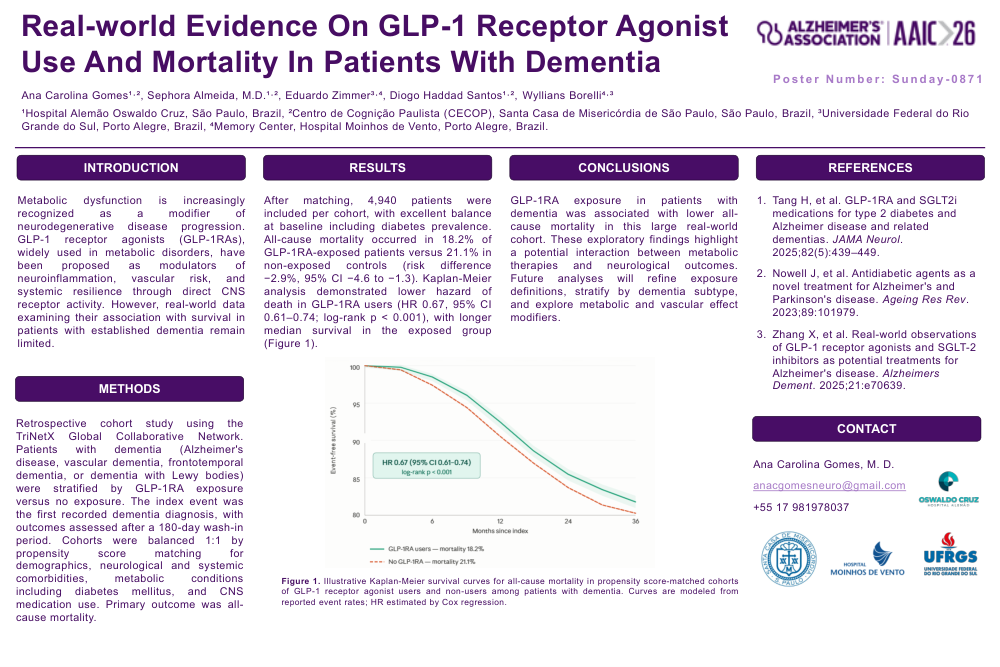
After matching, 4,940 patients were included per cohort, with excellent balance at baseline including diabetes prevalence. All-cause mortality occurred in 18.2% of GLP-1RA-exposed patients versus 21.1% in non-exposed controls (risk difference −2.9%, 95% CI −4.6 to −1.3). Kaplan-Meier analysis demonstrated lower hazard of death in GLP-1RA users (HR 0.67, 95% CI 0.61–0.74; log-rank p < 0.001), with longer median survival in the exposed group (Figure 1).
CONCLUSIONS
GLP-1RA exposure in patients with dementia was associated with lower all-cause mortality in this large real-world cohort. These exploratory findings highlight a potential interaction between metabolic therapies and neurological outcomes. Future analyses will refine exposure definitions, stratify by dementia subtype, and explore metabolic and vascular effect modifiers.
REFERENCES
- Tang H, et al. GLP-1RA and SGLT2i medications for type 2 diabetes and Alzheimer disease and related dementias. JAMA Neurol. 2025;82(5):439–449.
- Nowell J, et al. Antidiabetic agents as a novel treatment for Alzheimer's and Parkinson's disease. Ageing Res Rev. 2023;89:101979.
- Zhang X, et al. Real-world observations of GLP-1 receptor agonists and SGLT-2 inhibitors as potential treatments for Alzheimer's disease. Alzheimers Dement. 2025;21:e70639.
CONTACT Ana Carolina Gomes, M.D. anacgomesneuro@gmail.com +55 17 981978037
Comments
Email is required but is not shown publicly.
Loading comments...