4,068 posters, 219 videos, 101 topics, 69 sessions, 14,365 authors, 6,128 institutions
ePostersLive by SciGen Technologies S.A. All rights reserved.
Alzheimer's Association International Conference 2026
July 12-15, 2026 | London, United Kingdom, and Online

10695
Neuropsychological Profiles Across The Cognitive Aging-dementia Spectrum In Panamanian Older Adults: The PARI-HD Longitudinal Cohort
Poster Presenter
Authors
Sofia Rodriguez-Araña, Diana Oviedo, Adam Tratner, Alcibiades Villarreal, Anna V. Díaz, Carolina Rodríguez, Giselle Rangel, María B. Carreira, Gabrielle B. Britton
Affiliations
Florida State University, Instituto de Investigaciones Científicas y Servicios de Alta Tecnología (INDICASAT-AIP), Centro de Vacunación e Investigación (CEVAXIN)
Part of Topic
Title: Neuropsychological and functional profiles across the cognitive aging–dementia spectrum in Panamanian older adults: the PARI-HD Longitudinal Cohort
Authors: Rodríguez-Araña S., Oviedo D., Tratner A., Villarreal A., Díaz AV, Rodríguez C., Pauli Quirós E., Rangel G., Carreira MB., Britton, GB., Panama Aging Research Initiative-Health Disparities (PARI-HD).
Keywords (3):
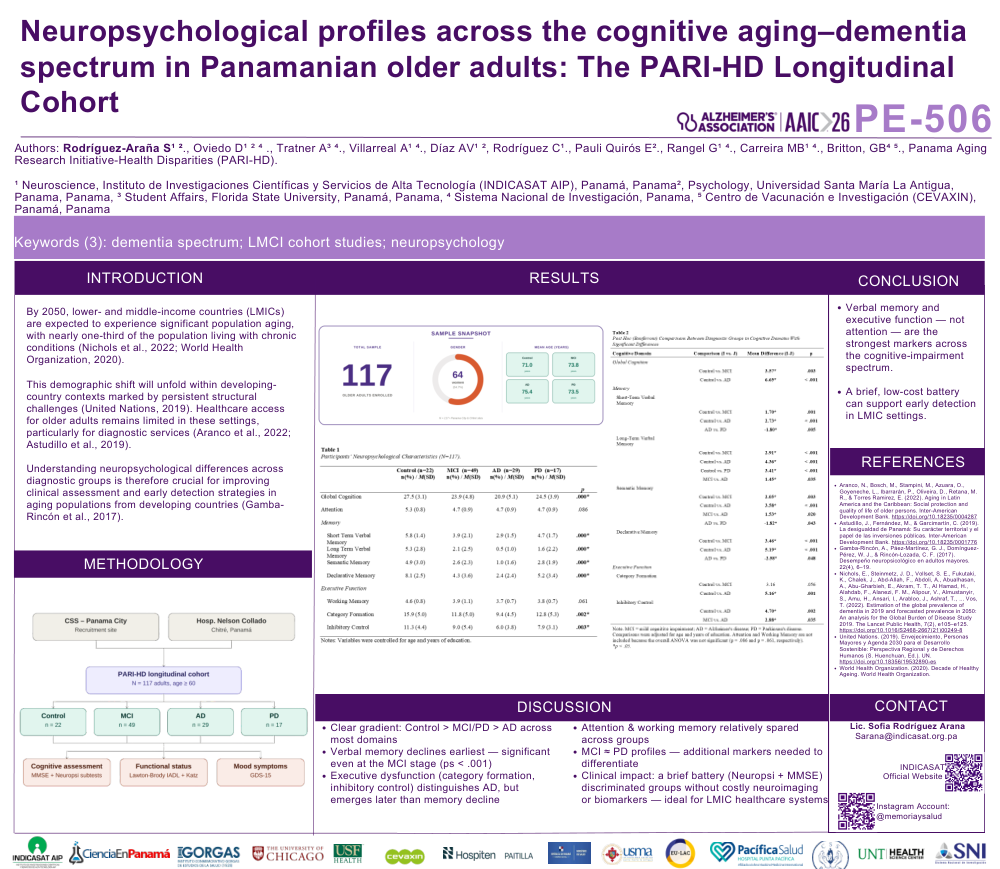
Background: By 2050, approximately one-third of the population in low- and middle-income countries (LMICs) will be aged 60 years or older. In these settings, age-related brain pathologies emerge within contexts marked by persistent structural challenges in the health, education, and economic sectors, as well as pronounced social inequalities. Characterizing neuropsychological differences across diagnostic groups is essential for improving clinical assessment and early detection strategies in aging populations from developing countries
Methodology: The study comprised a sample of 117 older adults recruited from the Metropolitan Social Security Fund (CSS) in Panama City and Dr. Nelson Collado Hospital in Chitré, Panama. Participants were classified into four diagnostic groups: cognitively healthy controls (n = 22), mild cognitive impairment (MCI; n = 49), Alzheimer’s disease (AD; n = 29), and Parkinson’s disease (PD; n = 17). Cognitive performance was assessed using selected subtests from the Neuropsi: Attention and Memory battery and the Mini-Mental State Examination (MMSE). Cognitive profile encompassed multiple domains: global cognition was evaluated using the MMSE. Attention span, memory (long term and short-term verbal memory, semantic, declarative memory), executive function (working memory, category formation and inhibitory control) was assessed through selected Neuropsi subitems. Functional status was evaluated using the Lawton and Brody Instrumental Activities of Daily Living Scale and the Katz Index of Activities of Daily Living, while depressive symptoms were measured using the 15-item Geriatric Depression Scale (GDS-15).
Results: The total sample consisted of 64 women (54.7%). Mean age (SD) by diagnostic group was 71.0 (4.7) years for cognitively healthy participants, 73.8 (6.1) years for the MCI group, 75.4 (5.8) years for the AD group, and 73.5 (5.4) years for the PD group. Significant differences were observed in global cognition, with cognitively healthy participants showing the highest MMSE scores and the AD group the lowest (p < .001). Across domain-specific neuropsychological measures adjusted for age and years of education, verbal memory domains showed robust group differences (ps < .001), following a clear performance gradient (controls > MCI/PD > AD). Executive functions, particularly category formation and inhibitory control, also differed significantly across groups (ps ≤ .003). In contrast, basic attention span and working memory showed only marginal group effects.
Conclusions: Distinct neuropsychological profiles were observed across diagnostic groups, with verbal memory and higher-order executive functions emerging as the most discriminative domains along the cognitive impairment spectrum, while attentional processes appeared relatively preserved. These findings underscore the clinical relevance of domain-specific neuropsychological assessment for characterizing cognitive aging and neurodegenerative conditions in LMIC settings and support the development of contextually informed diagnostic approaches to enhance early detection and clinical decision-making.
Comments
Email is required but is not shown publicly.
Loading comments...