4,068 posters, 219 videos, 101 topics, 69 sessions, 14,365 authors, 6,128 institutions
ePostersLive by SciGen Technologies S.A. All rights reserved.
Alzheimer's Association International Conference 2026
July 12-15, 2026 | London, United Kingdom, and Online

10656
Characterizing The Digital Phenotype And Executive Functions In Latam Older People With MCI
Poster Presenter
Authors
Maria Celeste López-Moreno, Daiana Bario, Florencia Ferreyra, Renata Diaz Colodrero, Estela Benitez, Carla Perez, Melania Lope, Guillermina Quenan, Claudia Arias, Leticia Vivas, Maria Marta Richard´s
Affiliations
Institute of Basic and Applied Psychology and Technology, National University of Mar del Plata, National Council of Scientific and Technical Research of Argentina, Faculty of Health Science and Social Work of the National University of Mar del Plata, Argentina
Part of Topic
Video
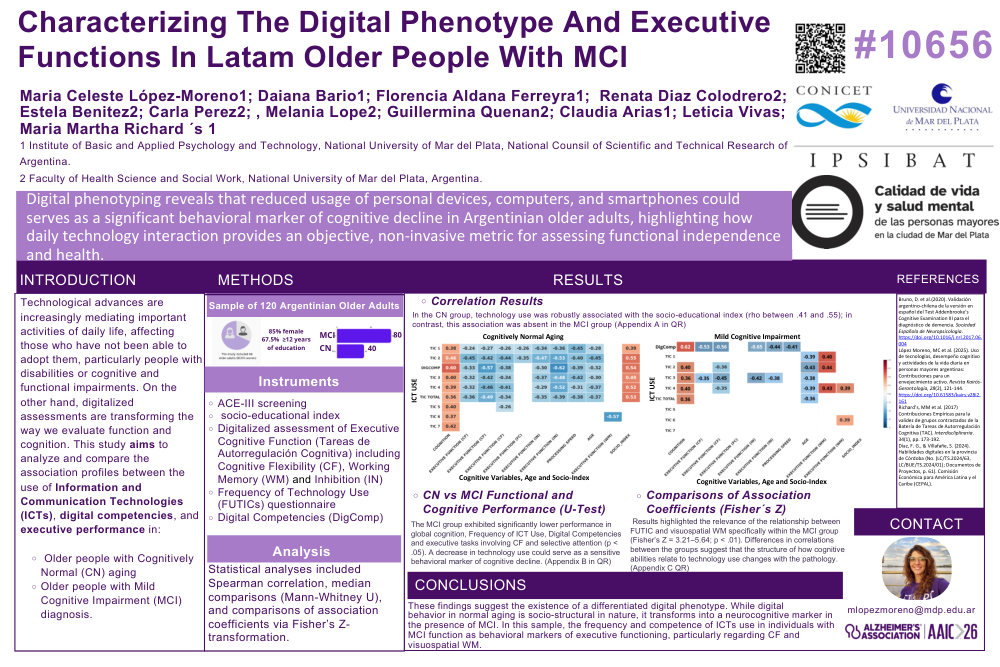
Introduction and Objective: Technological advances are increasingly mediating important activities of daily life, affecting those who have not been able to adopt them, particularly people with disabilities or cognitive and functional impairments. On the other hand, digitalized assessments are transforming the way we evaluate function and cognition. This study aims to analyze and compare the association profiles between the use of Information and Communication Technologies (ICTs), digital competencies, and executive performance in older adults with Cognitively Normal (CN) aging and those with Mild Cognitive Impairment (MCI).
Methodology: The sample comprised 120 participants from Mar del Plata, Argentina (80 CN and 40 MCI; 85% female; 67.5% with ≥12 years of education). MCI diagnosis was established based on clinical criteria, supplemented by ACE-III screening and socio-educational index. A digitalized executive function assessment battery (TAC) was administered to measure working memory (WM), inhibition (IN), and cognitive flexibility (CF). The technological profile was assessed using the Frequency of Technology Use (FUTIC) and Digital Competencies (DigComp) questionnaires. Statistical analyses included Spearman correlation, median comparisons (Mann-Whitney U), and comparisons of association coefficients via Fisher’s Z-transformation.
Results:In both groups, advanced age was associated with lower cognitive performance and reduced ICT use, while higher ICT use and digital competencies correlated with better cognitive outcomes. In the CN group, technology use was robustly associated with the socio-educational index (r between .41 and .55); in contrast, this association was absent in the MCI group. The MCI group exhibited significantly lower performance in global cognition, FUTIC (personal, community, and health dimensions), DigComp, and executive tasks involving CF and selective attention (p < .05). Comparison of association coefficients highlighted the critical relevance of the relationship between FUTIC and visuospatial WM specifically within the MCI group (Fisher’s Z = 3.21–5.64; p < .01).
Conclusion: These findings suggest the existence of a differentiated digital phenotype. While digital behavior in normal aging is socio-structural in nature, it transforms into a neurocognitive marker in the presence of MCI. In this sample, the frequency and competence of ICTs use in individuals with MCI function as behavioral markers of executive functioning, particularly regarding CF and visuospatial WM.
Comments
Email is required but is not shown publicly.
Loading comments...