4,068 posters, 219 videos, 101 topics, 69 sessions, 14,365 authors, 6,128 institutions
ePostersLive by SciGen Technologies S.A. All rights reserved.
Alzheimer's Association International Conference 2026
July 12-15, 2026 | London, United Kingdom, and Online

9656
Ventral And Dorsal Pathways, Education And Motor Function In Visuoconstructive Figure Copy Performance
Poster Presenter
Authors
Lorena Emanuelle Silva, Rafaela D'Angelo Machado, Giovanna Correia Pereira Moro, Joice Coutinho de Alvarenga, Gabriela Tomé Oliveira Engelmann, Felipe Pereira Ferreira Sales, Bruna Fulgêncio Dias, Marcilene Anacleto Melgaço, Rafaela Modenesi Venâncio Lepich, Isabella Sobroza Pereira Duarte, Marco Aurélio Fagundes Angelo, Débora Marques de Miranda, Marco Aurélio Romano-Silva, Luiz Armando Cunha de Marco, Bernardo de Mattos Viana, Maria Aparecida Camargos Bicalho, Jonas Jardim de Paula
Affiliations
Universidade Federal de Minas Gerais, Belo Horizonte, Brazil, Cog-Aging Research Group, Universidade Federal de Minas Gerais, Belo Horizonte, Brazil, Geriatrics and Gerontology Center Clinical Hospital, Universidade Federal de Minas Gerais, Belo Horizonte, Brazil, Older Adult’s Psychiatry and Psychology Extension Program (PROEPSI), Universidade Federal de Minas Gerais, Belo Horizonte, Brazil, Neurotec R National Institute of Science and Technology (INCT-Neurotec R), Universidade Federal de Minas Gerais, Belo Horizonte, Brazil, Department of Psychiatry, Universidade Federal de Minas Gerais, Belo Horizonte, Brazil, Department of Internal Medicine, Universidade Federal de Minas Gerais, Belo Horizonte, Brazil., Department of Psychiatry, Universidade Federal de Minas Gerais, Belo Horizonte, Brazil,
Part of Topic
Video
Ventral and Dorsal Pathways, Education and Motor Function in Visuoconstructive Figure Copy Performance
BACKGROUND
Visuoconstructive abilities depend on the integration of visuoperceptual, visuospatial, motor, and executive processes and are influenced by factors such as education, motor abilities, and executive functioning. Deficits in these abilities are common in dementia and other neurodegenerative disorders, yet most assessment tools provide only global scores, limiting the understanding of underlying cognitive mechanisms. This study examined the relative contributions of visuoperceptual, visuospatial, motor, and executive functions to performance on the Simplified Taylor Complex Figure Task (sTCFT) in older adults.
METHODS
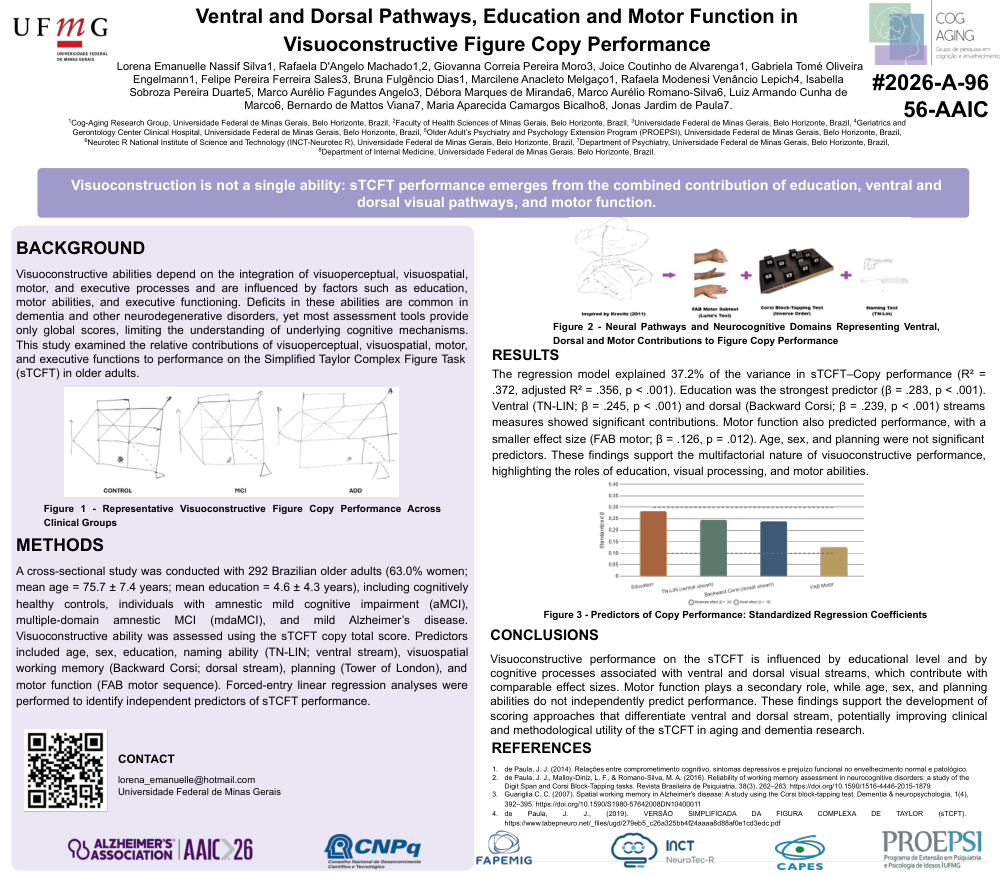
A cross-sectional study was conducted with 292 Brazilian older adults (63.0% women; mean age = 75.7 ± 7.4 years; mean education = 4.6 ± 4.3 years), including cognitively healthy controls, individuals with amnestic mild cognitive impairment (aMCI), multiple-domain amnestic MCI (mdaMCI), and mild Alzheimer’s disease. Visuoconstructive ability was assessed using the sTCFT copy total score. Predictors included age, sex, education, naming ability (TN-LIN; ventral stream), visuospatial working memory (Backward Corsi; dorsal stream), planning (Tower of London), and motor function (FAB motor sequence). Forced-entry linear regression analyses were performed to identify independent predictors of sTCFT performance.
The regression model explained 37.2% of the variance in sTCFT–Copy performance (R² = .372, adjusted R² = .356, p < .001). Education was the strongest predictor (β = .283, p < .001). Ventral (TN-LIN; β = .245, p < .001) and dorsal (Backward Corsi; β = .239, p < .001) streams measures showed significant contributions. Motor function also predicted performance, with a smaller effect size (FAB motor; β = .126, p = .012). Age, sex, and planning were not significant predictors. These findings support the multifactorial nature of visuoconstructive performance, highlighting the roles of education, visual processing, and motor abilities.
CONCLUSIONS
Visuoconstructive performance on the sTCFT is influenced by educational level and by cognitive processes associated with ventral and dorsal visual streams, which contribute with comparable effect sizes. Motor function plays a secondary role, while age, sex, and planning abilities do not independently predict performance. These findings support the development of scoring approaches that differentiate ventral and dorsal stream, potentially improving clinical and methodological utility of the sTCFT in aging and dementia research.
Comments
Email is required but is not shown publicly.
Loading comments...