4,068 posters, 219 videos, 101 topics, 69 sessions, 14,365 authors, 6,128 institutions
ePostersLive by SciGen Technologies S.A. All rights reserved.
Alzheimer's Association International Conference 2026
July 12-15, 2026 | London, United Kingdom, and Online

5493
Transient Beta Events Differentiate Successful Cognitive Aging And Mild Cognitive Impairment
Part of Topic
Transient Beta Events Differentiate Successful Cognitive ageing and Mild Cognitive Impairment
Blanca Pilar Carvajal1,2, Noemí López-Núñez1,2, Danylyna Shpakivska-Bilan1,2, María Eugenia López García1,2.
1. Complutense University of Madrid, Madrid, Spain; 2. Laboratory for Cognitive and Computational Neuroscience (C3N), Madrid, Spain.
Successful cognitive ageing appears to be associated with a distinct pattern of transient beta-band brain activity, and these event-based electroencephalography measures may be more sensitive markers of cognitive health than traditional average beta power measures.
INTRODUCTION
Successful cognitive ageing (SCA) is characterized by preserved cognitive performance despite advanced age and age-related brain changes1,2.
The neurophysiological mechanisms supporting cognitive resilience of SCA in the oldest-old, and their differences from pathological ageing, remain poorly understood.
Changes in resting-state beta-band oscillations (12-30 Hz) have been described in ageing, but time-averaged spectral power may obscure underlying signal structure3.
RESEARCH QUESTION: Do transient beta-event dynamics reveal cognitive ageing differences3?
METHODS
Participants: 34 Spanish older adults (18 SCA and 16 with Mild Cognitive Impairment, MCI); 85 ± 2 years).
Electroencephalography (EEG): 5 min eyes-closed resting-state
Beta events: Beta event expression characterised in Precuneus (brain region vulnerable to ageing and Alzheimer’s disease).
Beta spectral event features were quantified3,4 (i.e., event rate, duration, frequency span, and power) and compared between groups.
RESULTS
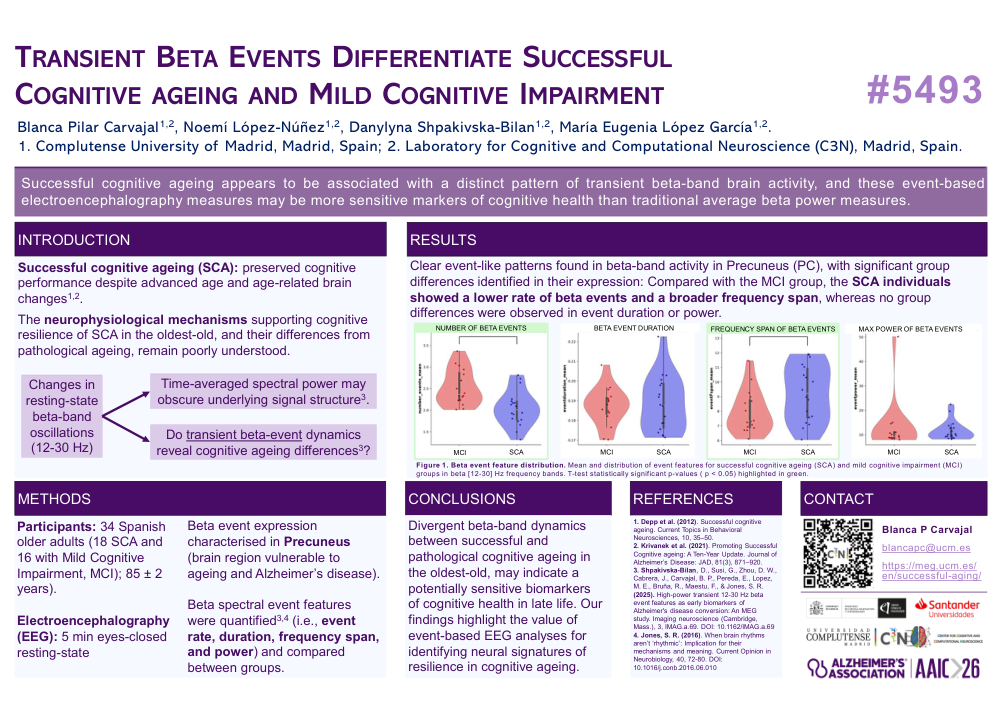
Clear event-like patterns found in beta-band activity in Precuneus (PC), with significant group differences identified in their expression: Compared with the MCI group, the SCA individuals showed a lower rate of beta events and a broader frequency span, whereas no group differences were observed in event duration or power.
Figure 1. Beta event feature distribution (number of beta events, beta event duration, frequency band of beta events, max power of beta events). Mean and distribution of event features for successful cognitive ageing (SCA) and mild cognitive impairment (MCI) groups in beta [12-30] Hz frequency bands. T-test statistically significant p-values ( p < 0.05) highlighted in green.
CONCLUSIONS
Divergent beta-band dynamics between successful and pathological cognitive ageing in the oldest-old, may indicate a potentially sensitive biomarkers of cognitive health in late life. Our findings highlight the value of event-based EEG analyses for identifying neural signatures of resilience in cognitive ageing.
REFERENCES
1 Depp et al. (2012). Successful cognitive ageing. Current Topics in Behavioral Neurosciences, 10, 35–50.
2 Krivanek et al. (2021). Promoting Successful Cognitive ageing: A Ten-Year Update. Journal of Alzheimer’s Disease: JAD, 81(3), 871–920.
3 Shpakivska-Bilan, D., Susi, G., Zhou, D. W., Cabrera, J., Carvajal, B. P., Pereda, E., Lopez, M. E., Bruña, R., Maestu, F., & Jones, S. R. (2025). High-power transient 12-30 Hz beta event features as early biomarkers of Alzheimer's disease conversion: An MEG study. Imaging neuroscience (Cambridge, Mass.), 3, IMAG.a.69. DOI: 10.1162/IMAG.a.69
4 Jones, S. R. (2016). When brain rhythms aren’t ‘rhythmic’: Implication for their mechanisms and meaning. Current Opinion in Neurobiology, 40, 72-80. DOI: 10.1016/j.conb.2016.06.010
Comments
Email is required but is not shown publicly.
Loading comments...