4,068 posters, 219 videos, 101 topics, 69 sessions, 14,365 authors, 6,128 institutions
ePostersLive by SciGen Technologies S.A. All rights reserved.
Alzheimer's Association International Conference 2026
July 12-15, 2026 | London, United Kingdom, and Online

7151
Early Cognitive Impairment Screening After Stroke In The Emergency Department: An Exploratory Study
Poster Presenter
Authors
Carlos Arellano-González, Hector Spinola-Maroño, Daniel García-Gutiérrez, Ilse Murrieta-Hernández, Ramiro Ruiz-García, Juan Carlos Lopez-Hernández, Raul Medina-Rioja
Affiliations
Neurology, Instituto Nacional de Neurología y Neurocirugía Manuel Velasco Suarez, Stroke Clinic, Instituto Nacional de Neurología y Neurocirugía Manuel Velasco Suarez, Cognitive Neurology and Dementia Clinic, Instituto Nacional de Neurología y Neurocirugía Manuel Velasco Suarez, Neurophysiology, Instituto Nacional de Neurología y Neurocirugía Manuel Velasco Suarez
Part of Topic
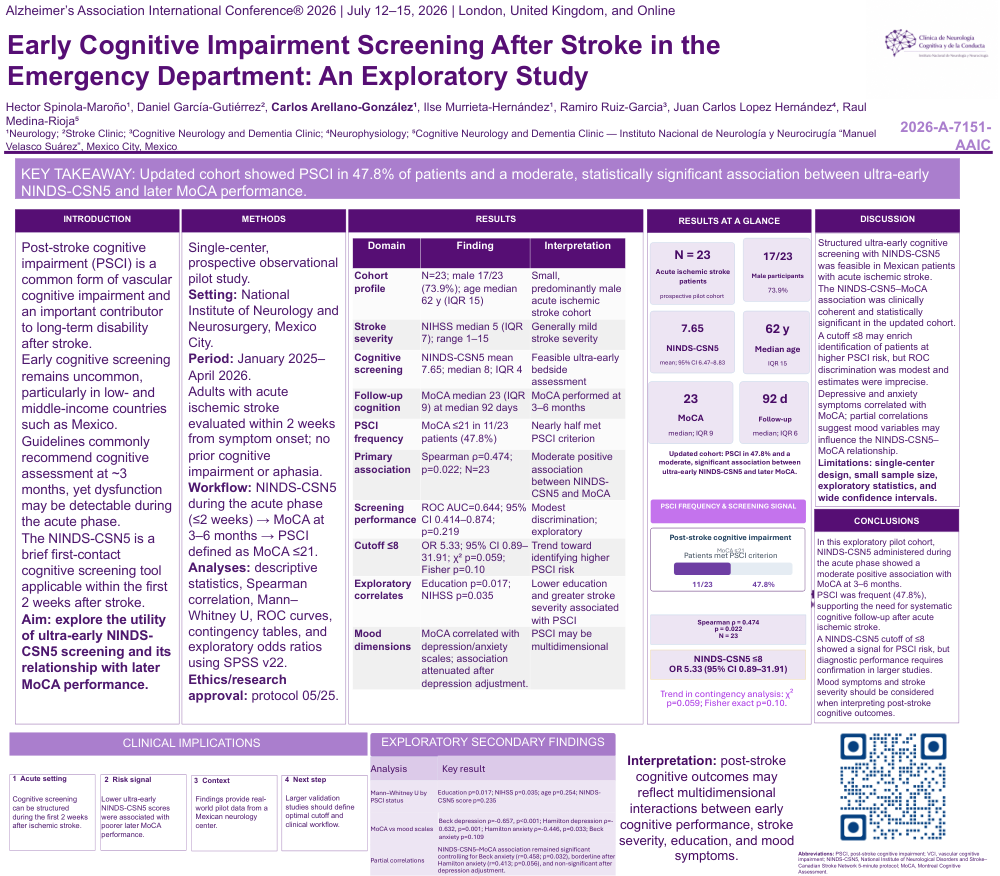
This prospective pilot study evaluated the use of the NINDS-CSN5 as an ultra-early cognitive screening tool in Mexican patients with acute ischemic stroke. Twenty-three patients were assessed within the first two weeks after symptom onset and underwent follow-up cognitive evaluation with the Montreal Cognitive Assessment at 3–6 months.
The main finding was a moderate and statistically significant positive correlation between ultra-early NINDS-CSN5 scores and later MoCA performance (r=0.5, p=0.022), indicating that worse cognitive performance during the acute phase was associated with poorer cognitive outcomes during follow-up. A NINDS-CSN5 cutoff of ≤8 was associated with increased odds of post-stroke cognitive impairment at 3–6 months (OR 5.33, 95% CI 0.89–31.91), although this showed only a trend toward statistical significance. Receiver operating characteristic analysis suggested modest discriminative ability, supporting the exploratory nature of these findings. Additional analyses suggested that greater stroke severity and lower educational attainment were also associated with worse cognitive outcomes.
In conclusion, structured ultra-early cognitive screening with the NINDS-CSN5 was feasible in Mexican patients with acute ischemic stroke and showed a clinically relevant association with subsequent cognitive performance. These results suggest that cognitive assessment during the acute phase of stroke care may help identify patients at higher risk for post-stroke cognitive impairment, allowing earlier follow-up and potentially earlier cognitive-oriented rehabilitation strategies. Given the single-center design, small sample size, and exploratory analyses, larger multicenter studies are needed to validate these findings, refine optimal cutoff values, and define the clinical utility of ultra-early cognitive screening in Latin American stroke populations.
Comments
Email is required but is not shown publicly.
Loading comments...