4,068 posters, 219 videos, 101 topics, 69 sessions, 14,365 authors, 6,128 institutions
ePostersLive by SciGen Technologies S.A. All rights reserved.
Alzheimer's Association International Conference 2026
July 12-15, 2026 | London, United Kingdom, and Online

4130
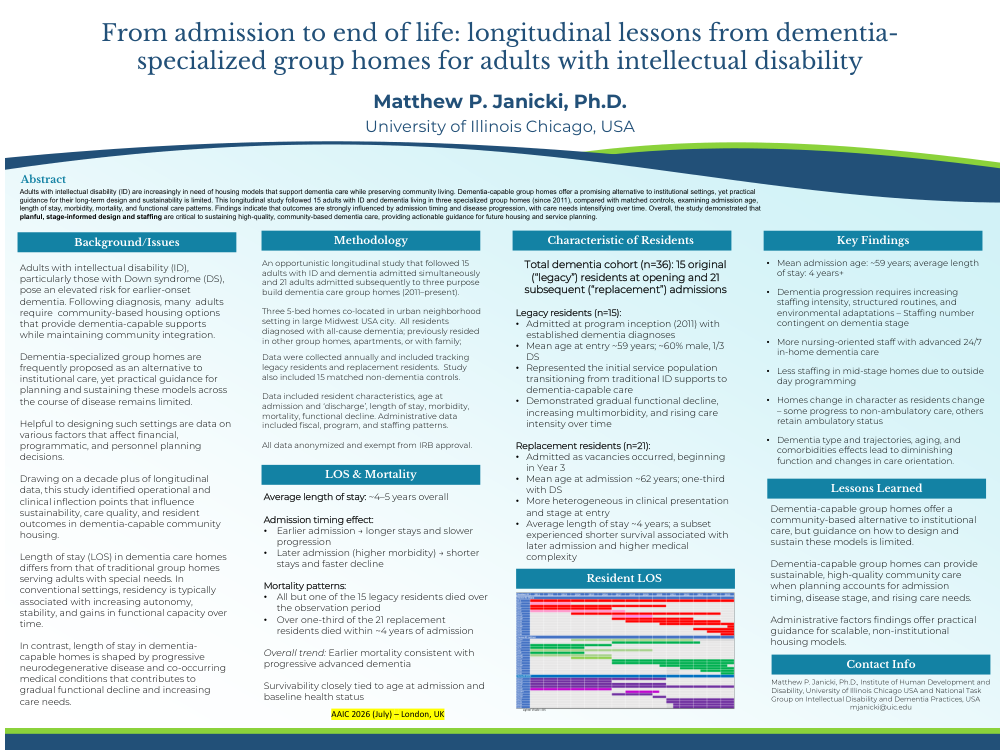
From Admission To End Of Life: Longitudinal Lessons From Dementia-specialized Group Homes For Adults With Intellectual Disability
Poster Presenter
Authors
Affiliations
Part of Topic
Background
Adults with intellectual disability (ID) are a growing and underserved population at elevated risk for Alzheimer’s disease and related dementias, particularly individuals with Down syndrome, who often experience earlier onset. Following diagnosis, many require housing options that provide dementia-capable supports while maintaining community integration. Dementia-specialized group homes are frequently proposed as an alternative to institutional care, yet practical guidance for planning and sustaining these models across the course of disease remains limited. Drawing on more than a decade of longitudinal data, this study identifies operational and clinical inflection points that influence sustainability, care quality, and resident outcomes in dementia-capable community housing.
Objectives
To identify clinically and operationally relevant factors that inform the design, implementation, and sustainability of dementia-capable community group homes for adults with ID, with attention to admission timing, disease trajectories, staffing intensity, morbidity, mortality, and care transitions.
Methods
This longitudinal observational study followed three co-located dementia-capable group homes (five residents per home) serving adults with ID and dementia beginning in 2011. Fifteen residents were followed from admission through disease progression and death and compared with matched non-dementia controls. Data included age at admission, length of stay, morbidity burden, mortality, functional change, staffing patterns, and non-pharmacologic care practices. Findings were contextualized using comparative data from dementia group homes in multiple countries examining environmental adaptations and staffing demands.
Results
Admission age emerged as a key determinant of length of stay, morbidity trajectories, and mortality, with a tri-modal clustering of admissions in the early 50s, late 50s, and mid-to-late 60s. Mean age at entry was approximately 59 years, with an average length of stay just over four years. Residents admitted at older ages with greater health complexity experienced shorter survival, whereas adults with Down syndrome were typically admitted earlier and accrued more life-years in group homes despite earlier mortality. Comparative data from dementia-specialized group homes in multiple countries further demonstrated that effective care models shared common features, including stage-based resident grouping, progressive increases in staffing ratios as dementia advanced, and targeted workforce training in dementia-capable communication, engagement, and daily routine support. Across settings, environmental and programmatic adaptations intensified over time, with rising staff demands related to hygiene assistance, management of behavioral symptoms, and provision of end-of-life care.
Conclusions
Dementia-specialized group homes can provide sustainable, high-quality community-based care for adults with ID when planning explicitly accounts for dementia stage, admission age, morbidity burden, staffing escalation, and anticipated care transitions. These findings offer actionable guidance for providers, policymakers, and service systems seeking scalable housing models that reduce reliance on institutional care and support aging in community.
Comments
Email is required but is not shown publicly.
Loading comments...