4,068 posters, 219 videos, 101 topics, 69 sessions, 14,365 authors, 6,128 institutions
ePostersLive by SciGen Technologies S.A. All rights reserved.
Alzheimer's Association International Conference 2026
July 12-15, 2026 | London, United Kingdom, and Online

4605
Digital Environmental Enrichment For Dementia Prevention: The REMINDEr Randomized Controlled Study Of An Online Multimodal Intervention
Poster Presenter
Authors
Part of Topic
Video
Background: Multidomain or multimodal lifestyle interventions targeting multiple modifiable dementia risk factors are a core pillar of dementia risk reduction strategies (Rosenberg et al., 2020). Approaches that integrate simultaneous physical, cognitive, emotional, and social stimulation can be conceptualized as environmental enrichment. When delivered remotely, such digital environmental enrichment may increase accessibility, scalability, and inclusivity. The evidence for digital multimodal interventions and their multidomain effects in older adults remains limited.
Objective: The REMINDer study evaluated the feasibility, safety, and preliminary effects of a short-term online multimodal mind-body group intervention as a low-threshold dementia prevention strategy.
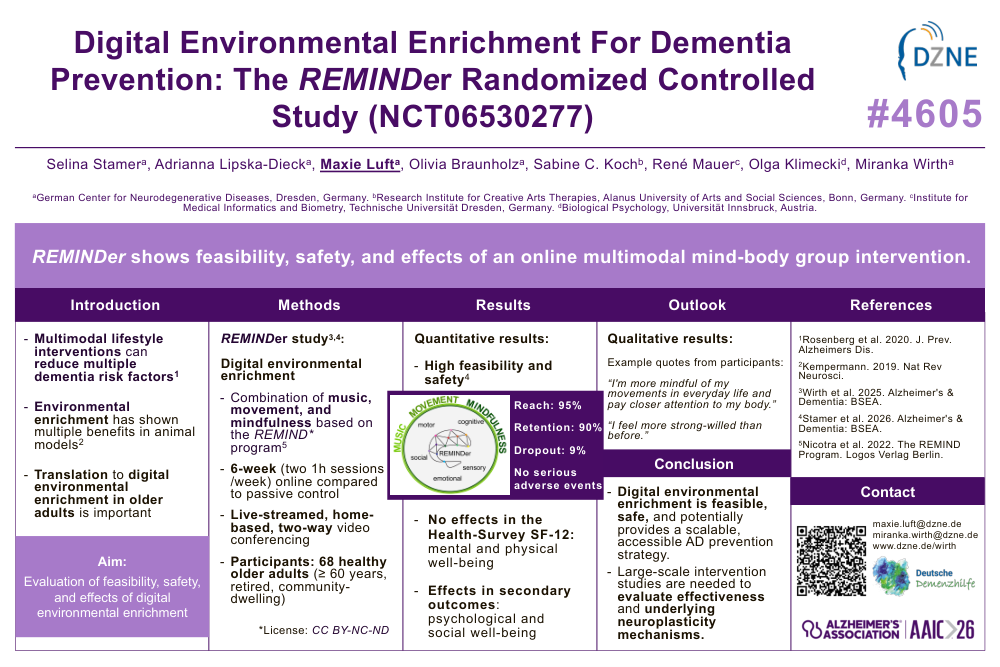
Methods: REMINDer (NCT06530277) was a fully remote pilot randomized controlled study (Wirth et al., 2025). Community-dwelling, cognitively unimpaired adults (≥60 years) were randomized (1:1) to a novel 6-week online multimodal mind-body group intervention, delivered via live-streamed, home-based, two-way video conferencing, or a passive control with delayed intervention. Participants attended twice-weekly, 60-minute supervised online group sessions that integrated physical, cognitive, emotional, and social stimulation through music, dance-based movement, and mindfulness practices. Primary outcomes were feasibility (adherence benchmark: ≥60%) and self-reported mental and physical well-being (SF-12 Health Survey). Secondary outcomes included physical, cognitive, emotional, and social domains, assessed using domain-specific measures and the multidomain self-reported Dunphy Outcomes Framework (DOF-BREVE-SR) (Dunphy et al., 2023). Primary and secondary analyses were conducted using linear mixed-effects models.
Results: Sixty-eight participants were included in primary (mean age: ~69 years; ~80% women), and 57 in secondary analyses. Mean adherence was 80%, exceeding the pre-defined feasibility benchmark. Secondary outcomes showed high feasibility, including reach (95%), retention (90%), and low dropout (9%). No serious adverse events occurred. No between-group differences were observed in the SF-12 mental and physical well-being post-intervention. Small-to-moderate between-group effect sizes were observed for the DOF-BREVE-SR post-intervention, including the total score and psychological, social, and physical subdomains.
Conclusion: The remotely delivered multimodal lifestyle intervention was feasible, safe, and well accepted in healthy older adults. Although no short-term effects were observed on domain-specific outcomes, enrichment-sensitive outcomes indicated multidomain changes. These findings support digital environmental enrichment as a potentially scalable, accessible intervention strategy and may inform the design and evaluation of larger dementia risk reduction trials.
Comments
Email is required but is not shown publicly.
Loading comments...