4,068 posters, 219 videos, 101 topics, 69 sessions, 14,365 authors, 6,128 institutions
ePostersLive by SciGen Technologies S.A. All rights reserved.
Alzheimer's Association International Conference 2026
July 12-15, 2026 | London, United Kingdom, and Online

2692
Early Sphingolipid Metabolism Alterations Precede Canonical Alzheimer’S Biomarkers In Psen1-e280a Carriers
Poster Presenter
Authors
Laura Alejandra Lozano-Trujillo, Nelson David Galvis-Garrido, Juan Pablo Barbosa-Carvajal, Ivan Daniel Salomón-Cruz, Sara Camila Agudelo-Castrillon, Kenneth Kosik, Daniel Camilo Aguirre, David Aguillón, Estela Area-Gómez, Gloria Patricia Cardona-Gómez
Affiliations
Grupo de Neurociencias de Antioquia. Facultad de Medicina, Universidad de Antioquia, UCSB USA, CIB, CSIC, Spain
Part of Topic
Video
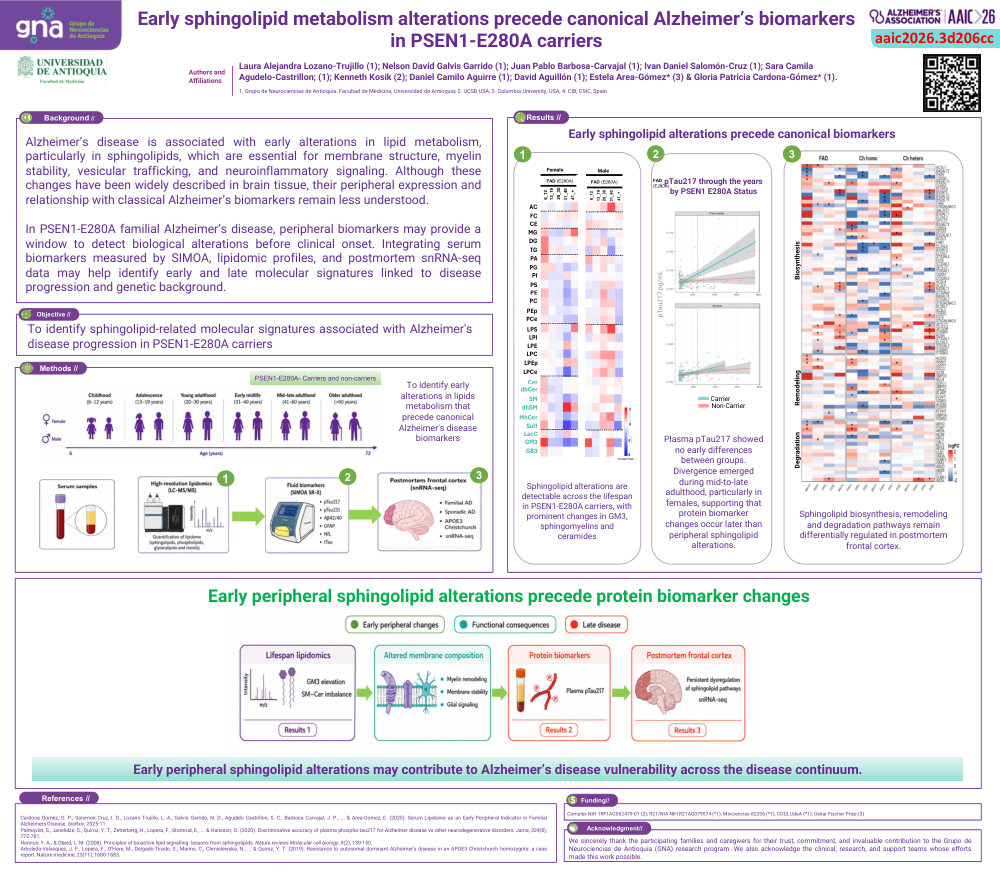
Early sphingolipid metabolism alterations precede canonical Alzheimer’s biomarkers in PSEN1-E280A carriers
Laura Alejandra Lozano-Trujillo (1); Juan Pablo Barbosa-Carvajal (1); Ivan Daniel Salomón-Cruz (1); Sara Camila Agudelo-Castrillon; (1); Nelson David Galvis Garrido (1); Kenneth Kosik (2); Daniel Camilo Aguirre (1); David Aguillón (1); Estela Area-Gómez* (3,4) & Gloria Patricia Cardona-Gómez* (1).
- Grupo de Neurociencias de Antioquia. Facultad de Medicina, Universidad de Antioquia; 2. UCSB USA; 3. Columbia University, USA; 4. CIB, CSIC, Spain.
Early detection of Alzheimer’s disease (AD) continues to rely primarily on protein biomarkers that reflect downstream stages of the pathological cascade, limiting the identification of early biological processes that confer neuronal vulnerability [1,2]. In this context, lipid metabolism has emerged as a relevant early layer of AD pathophysiology. Sphingolipids play critical roles in neurodevelopment, membrane organization, myelination, and glial function, positioning them as potential upstream drivers of changes that precede the characteristic protein aggregation of the disease [3].
In this study, we analyzed high-resolution serum lipidomics data obtained across the lifespan (6-72 years) in individuals from the Colombian PSEN1-E280A kindred and non-carrier controls. These data were integrated with protein biomarkers measured using SIMOA technology and with postmortem cortical analyses, with a targeted focus on major sphingolipid classes, including gangliosides, sphingomyelins, and ceramides, and on the regulation of key enzymes within the sphingomyelin-ceramide axis [4].
PSEN1-E280A carriers exhibited an early and sustained disruption of sphingolipid metabolism beginning in childhood, characterized by persistent elevation of the GM3 ganglioside and an early imbalance of the sphingomyelin-ceramide axis. These alterations preceded by decades the detectable increase of canonical AD biomarkers, such as plasma p-tau217 [1,2]. In postmortem brain tissue, reductions in sphingomyelin and ceramide levels were observed in both familial and sporadic AD, suggesting a shared pattern of sphingolipid dysregulation associated with neurodegeneration. In contrast, APOE3 Christchurch carriers preserved ceramide pools, consistent with adaptive mechanisms of metabolic resilience [5].
Taken together, these findings indicate that disruption of sphingolipid metabolism represents an early event in the AD trajectory, preceding classical protein biomarkers and enabling the discrimination of vulnerability and resilience pathways. Thus, sphingolipid pathways emerge as upstream biological drivers of AD and as promising candidates for early risk stratification and primary prevention strategies.
Referencias
- Palmqvist, S., Janelidze, S., Quiroz, Y. T., Zetterberg, H., Lopera, F., Stomrud, E., ... & Hansson, O. (2020). Discriminative accuracy of plasma phospho-tau217 for Alzheimer disease vs other neurodegenerative disorders. Jama, 324(8), 772-781.
- Thijssen, E. H., La Joie, R., Strom, A., Fonseca, C., Iaccarino, L., Wolf, A., ... & Boxer, A. L. (2021). Plasma phosphorylated tau 217 and phosphorylated tau 181 as biomarkers in Alzheimer's disease and frontotemporal lobar degeneration: a retrospective diagnostic performance study. The Lancet Neurology, 20(9), 739-752.
- Hannun, Y. A., & Obeid, L. M. (2008). Principles of bioactive lipid signalling: lessons from sphingolipids. Nature reviews Molecular cell biology, 9(2), 139-150.
- Cardona Gomez, G. P., Salomon Cruz, I. D., Lozano Trujillo, L. A., Galvis Garrido, N. D., Agudelo Castrillon, S. C., Barbosa Carvajal, J. P., ... & Area-Gomez, E. (2025). Serum Lipidome as an Early Peripheral Indicator in Familial Alzheimers Disease. bioRxiv, 2025-11.
- Arboleda-Velasquez, J. F., Lopera, F., O’Hare, M., Delgado-Tirado, S., Marino, C., Chmielewska, N., ... & Quiroz, Y. T. (2019). Resistance to autosomal dominant Alzheimer’s disease in an APOE3 Christchurch homozygote: a case report. Nature medicine, 25(11), 1680-1683.
Funding: Complex NIH 1RF1AG062479-01 (Kenneth Kosik); R21/NIA NIH R21AG079574 (Gloria Patricia Cardona-Gómez), Minciencias 82336 (Gloria Patricia Cardona-Gómez), CODI, UdeA (Gloria Patricia Cardona-Gómez); Oskar Fischer Prize (Estela Area-Gómez)
Comments
Email is required but is not shown publicly.
Loading comments...