4,068 posters, 219 videos, 101 topics, 69 sessions, 14,365 authors, 6,128 institutions
ePostersLive by SciGen Technologies S.A. All rights reserved.
Alzheimer's Association International Conference 2026
July 12-15, 2026 | London, United Kingdom, and Online

701
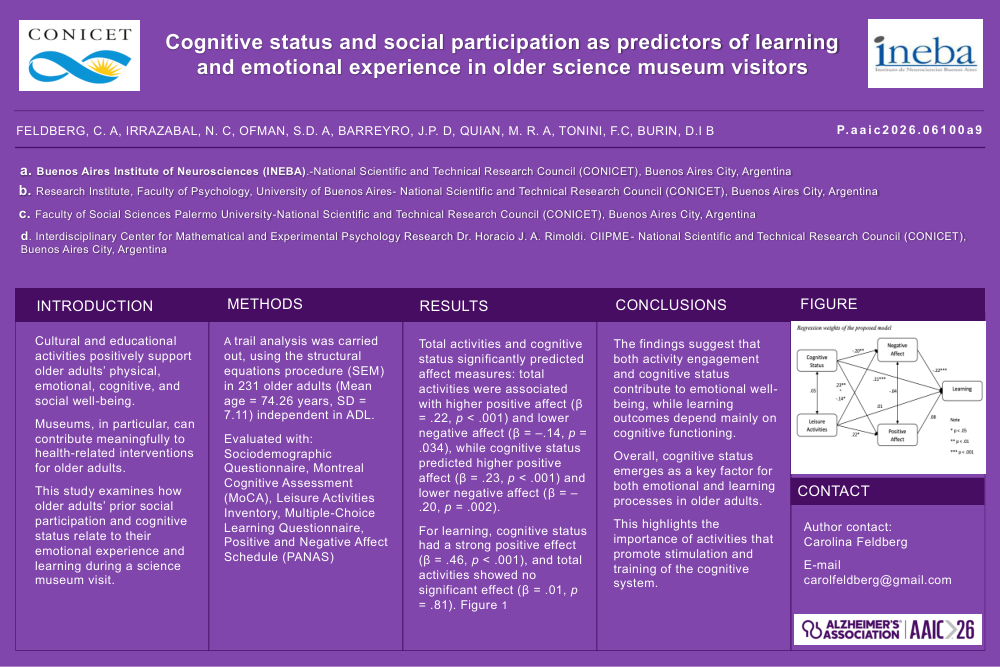
Cognitive Status And Social Participation As Predictors Of Learning And Emotional Experience In Older Science Museum Visitors
Poster Presenter
Authors
Carolina Feldberg, Natalia Irrazabal, Silvia Deborah Ofman, Juan Pablo Barreyro, María del Rosario Quian, Fernando Tonini, Debora Burin
Affiliations
Buenos Aires Institute of Neurosciences (INEBA).-National Scientific and Technical Research Council (CONICET), Faculty of Social Sciences Palermo University-National Scientific and Technical Research Council (CONICET, Interdisciplinary Center for Mathematical and Experimental Psychology Research Dr. Horacio J. A. Rimoldi. CIIPME- National Scientific and Technical Research Council (CONICET), Buenos Aires City, Argentina, Faculty of Social Sciences Palermo University-, Research Institute. Faculty of Psychology, University of Buenos Aires- National Scientific and Technical Research Council (CONICET),
Part of Topic
Background: Cultural and educational activities positively support older adults’ physical, emotional, cognitive, and social well-being, positioning cultural institutions as valuable complements to healthcare services within social prescribing frameworks. Museums, in particular, can contribute meaningfully to health-related interventions for older adults. This study examines how older adults’ prior social participation and cognitive status relate to their emotional experience and learning during a science museum visit.
Methods: A trail analysis was carried out, using the structural equations procedure (SEM) in 231 older adults (Mean age = 74.26 years, SD = 7.11) independent in ADL. Evaluated with: Sociodemographic Questionnaire, Montreal Cognitive Assessment (MoCA), Leisure Activities Inventory, Multiple-Choice Learning Questionnaire, Positive and Negative Affect Schedule (PANAS)
Results: Total activities and cognitive status significantly predicted affect measures: total activities were associated with higher positive affect (β = .22, p < .001) and lower negative affect (β = –.14, p = .034), while cognitive status predicted higher positive affect (β = .23, p < .001) and lower negative affect (β = –.20, p = .002). For learning, cognitive status had a strong positive effect (β = .46, p < .001), and total activities showed no significant effect (β = .01, p = .81).
Conclusions: The findings suggest that both activity engagement and cognitive status contribute to emotional well-being, while learning outcomes depend mainly on cognitive functioning. Overall, cognitive status emerges as a key factor for both emotional and learning processes in older adults. This highlights the importance of activities that promote stimulation and training of the cognitive system.
Comments
Email is required but is not shown publicly.
Loading comments...